William Inboden and the Transformation of the University of Texas at Austin
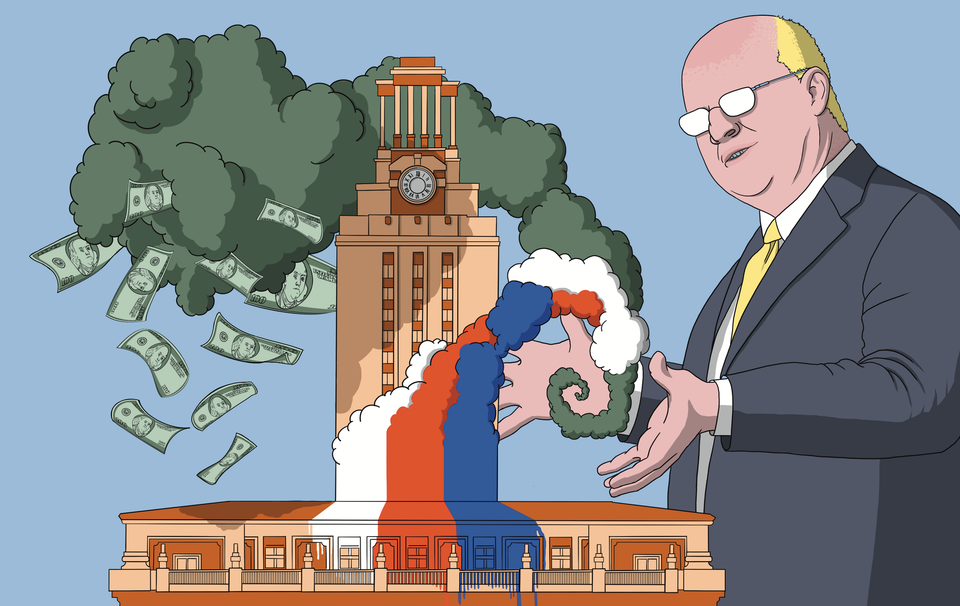
In August of last year, William Inboden began serving as the new executive vice president and provost of the University of Texas at Austin (hereafter UT Austin). In addition to obviously being one position below UT Austin’s president, Jim Davis, the executive vice president/provost is a hyphenated position at the university that puts Inboden in charge of seven portfolios, including Academic Affairs and both the Graduate School and Undergraduate Education.
One way to compare the roles of both the president and executive vice-president/provost ("executive" so as not to confuse Inboden with the many other vice presidents UT Austin employs) is to describe the president's work as promoting and steering the university in a macro capacity by meeting with and overseeing various councils and boards of directors; the provost, meanwhile, is in charge of concrete changes to the inner workings of UT Austin that affect both how students and faculty experience studying/working at the school, and subsequently how the university is seen from the outside.
In a guide to university terminology published by Youngstown State University, they describe the president's role as "the final decision maker when it comes to most things involved on campus," and the provost as "responsible for making the final decision on all academic changes within the university." Mileage surely varies by university, but these general descriptions sound accurate to me based on UT Austin's own descriptions of Davis's and Inboden's duties.
Inboden was born in 1972, making him something of a stealth Gen X figure in a prominent position and outside of the squabbling generational warfare of boomers and millennials. He is also a self-described conservative, but was not always so. In his book The Peacemaker: Ronald Reagan, the Cold War, and the World on the Brink, Inboden includes, in the photo section, an image of a poster referring to Reagan as an “insane anglo warlord.” The caption accompanying the image says: "As a teenager during the 1980s, the author hung this poster on his bedroom wall. He has since revised his assessment of Reagan." His belief that a university education truly molds the minds of younger generations appears to have been earned from experience.
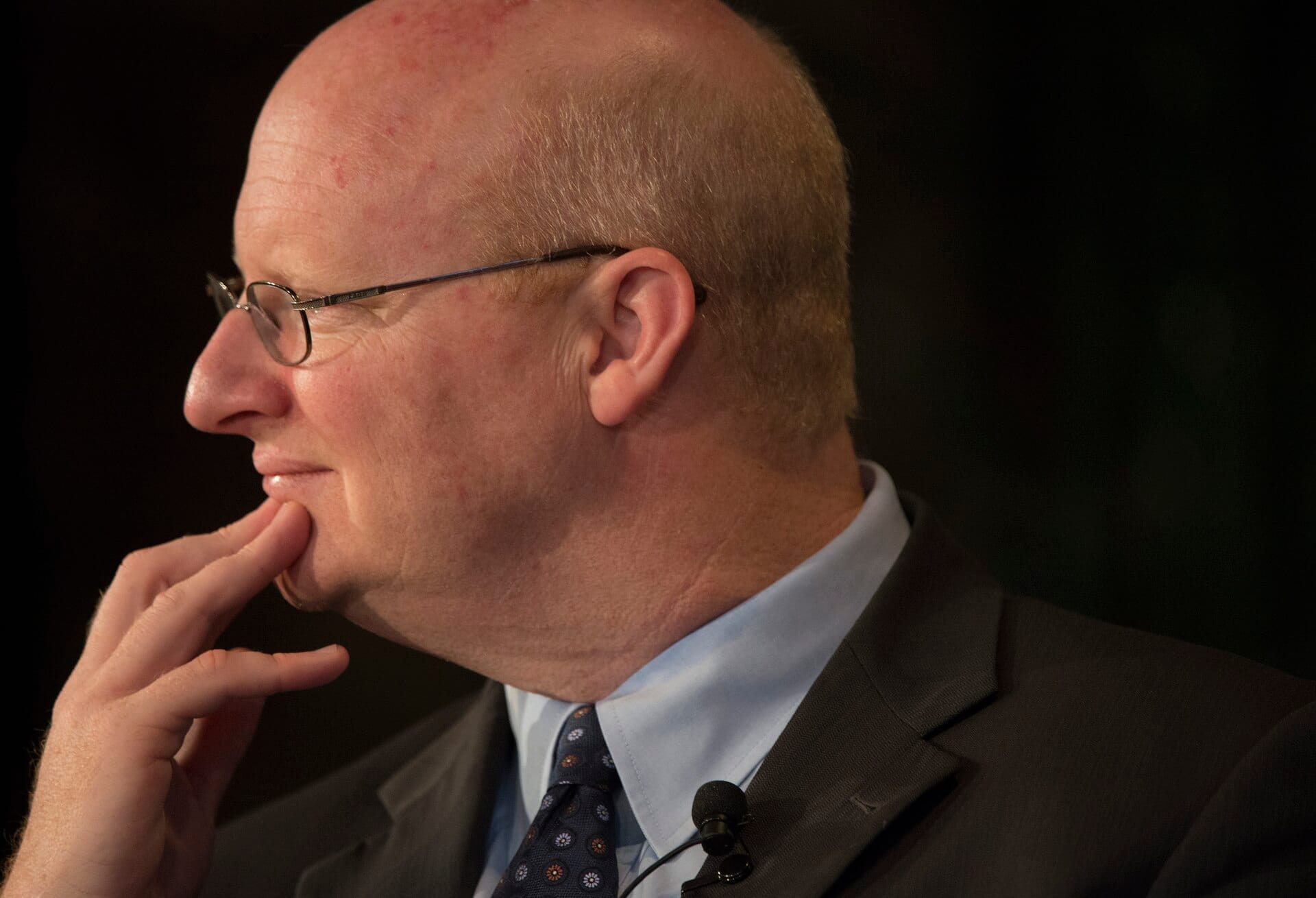
Unlike president Davis, who graduated from UT Austin and whose father was a member of the faculty, Inboden attended two prominent private schools — first Stanford, then Yale — earning degrees in history at both. After graduation he has had an extraordinary amount of jobs and fellowships. In a Christianity Today piece published in 2000 ("Policy Wonks for Christ"), we learn that after Yale, Inboden went to Capitol Hill to work for both Sam Nunn and Tom DeLay, "which showed me the day in, day out sausage-making of practical politics," he says. The reason he was being profiled by Christianity Today, however, was that he was taking part in a program that constructed a religious lens through which to understand power and policy in the United States. "I realized I was not equipped with a theoretical framework that would help me approach politics as a Christian," he told the magazine.
.jpg?ref=the-austin-tadarida.ghost.io)
Inboden and other subjects of this piece were taking part in something called the Civitas program, "sponsored by the Pew Charitable Trust, which cooperates with the Center for Public Justice, the Brookings Institution, and the American Enterprise Institute (AEI)." Following the Civitas program, Inboden was working directly for AEI in their offices in Washington, D.C. when the planes hit the twin towers.
"Every generation has its 'Where Were You When…?' dates," wrote Inboden in an editorial for the Daily Texan in 2014. "For my parents’ generation — the most poignant 'where were you when' question is the assassination of President John F. Kennedy on November 21, 1963. The moment that, for each American who heard that awful news, is forever seared in their memories. In my generation’s childhood years, the main such moments were hearing that President Ronald Reagan had been shot, and five years later learning that the space shuttle Challenger had exploded. Those were my generation’s defining dates — until Sept. 11, 2001."
Similar sentiments were expressed in a cubic ton of "personal essay" portions of college applications submitted for at least a decade after the towers were hit. However, few essayists would have such a close proximity to the powers crafting a response to that terrorism. Inboden went to work for the Bush administration as the senior director for strategic planning on the National Security Council at the White House.
When Inboden later grappled with what eventually happened — and didn’t — regarding the Iraq war, honest reflection escapes him. Just three years ago, Inboden was one of three co-editors (in addition to an additional, main editor) of a brick of a book called Hand-Off which, authored by people in the Bush administration, sets out on the task of grading themselves (resulting in a B+ and A+ report card) on the "hand-off" between the exiting Bush and incoming Obama administration.
In the section on Iraq — under the heading, "What Has Happened Since the End of the Bush Administration?" — the authors write that "President Obama inherited a stable, if fragile situation in Iraq and a well-defined relationship between the United States and Iraq." We are walked through the council elections that took place after Bush left office, and learn that "the national elections of 2010 ended up undermining it ["Iraq’s fragile democracy"], further empowering [Prime Minister Nouri al-] Maliki and enhancing Iran’s influence over the country’s politics." And then? "From this point forward, Iraq’s prospects began to dim." For Inboden, these problems would remain dim and become distant. He left that war behind and moved back into higher education.
Inboden became the founding executive director of UT Austin's Clements Center for National Security. After ten years in this position, Inboden moved to Florida to become the professor and director of something called the Hamilton School for Classical and Civic Education at the University of Florida, where he was hired by university president (and his friend) Ben Sasse. His return to UT Austin as provost and vice president is both a step forward and back; he returned to take a job at a university he had willingly left, but now his dominion extends over the entire school, not just one small and obscure part of it.
Inboden’s tenure as an academic and public intellectual has been fortified by private money since at least his time in the Civitas program. After leaving Civitas, Inboden drew closer to that money’s source by working directly for the AEI, and he continues to use AEI's house organ, a journal called National Affairs, to broadcast his philosophy of what higher education is and should be (we will get to that shortly).
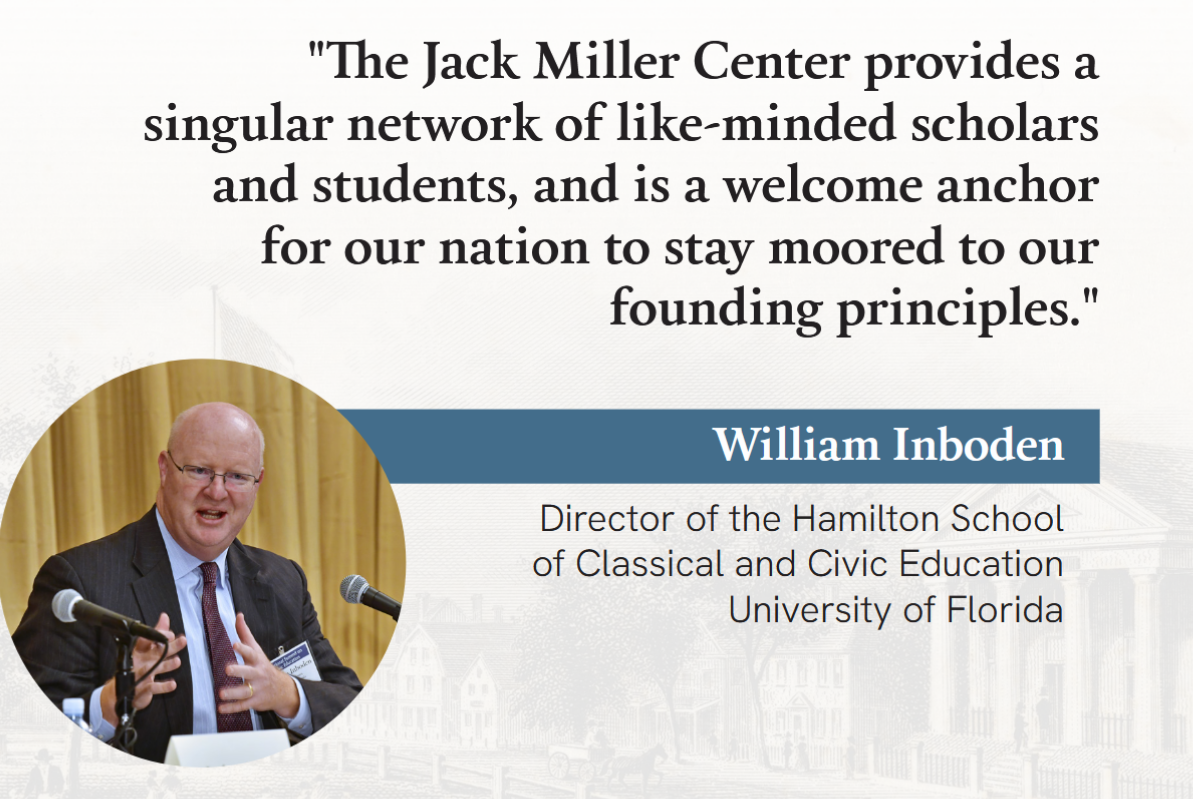
Another source of income and support for Inboden has been the Jack Miller Center (JMC), a private foundation with an increasing reach into the public domain. Neither the nonagenarian Miller nor his Center are currently on Wikipedia — something of a surprise given its reach — but here is some of what we do know about Jack Miller and the Center he christened after himself.
In 1956, Jack Miller founded an office supply business called the Quill Corporation, which was sold to Staples in 1998. Having left the Big & Tall Office Chairs business behind, Miller finally had the time and money to fulfill his goal of "bringing America’s founding history, documents, and ideas back into our nation’s classrooms."
The JMC filed its first private foundation tax return in 2007, showing an already healthy investment in public relations ($12,949) in its first year (in 2008, that number would closer to 10 times that amount — $108,583). The most recent tax data from the institute is from 2024, and lists 22 individuals as "Officers, Directors, Trustees, Key Employees, and Highest Compensated Employees." That year "THE JACK MILLER CENTER FOR TEACHING AMERICA'S FOUNDING PRINCIPLES AND" (full name is cut off on the form) reported having $13,411,276 in net assets.
What exactly are they doing with all of this money? On JMC's "Our Work" page, it reads: "We are building a movement of civic educators to reach the next generation with the principles of equality, liberty, and opportunity that lie at the heart of the American political tradition." To try and pierce those vagaries, let’s look at what this piece mostly concerns — higher education. Under the umbrella of their "American Political Tradition Project" you'll find programs like an academic journal, a fellowship, and Schools of Civic Thought.
It is under the auspices of these Schools of Civic Thought where we once again encounter William Inboden. The Hamilton School for Classical and Civic Education, which employed Inboden, is a partner institution with the JMC, and it was the JMC's private money (later buoyed by public money as well) that has helped keep the Hamilton School solvent and growing. Inboden currently holds "a joint faculty appointment with the School of Civic Leadership and the Department of History" at UT Austin — the former is also a JMC partner organization.
As provost/executive vice president of UT Austin, Inboden has begun acting on his (and the JMC’s) vision to create a different kind of public higher education. In his long piece for National Affairs, Inboden argues that universities have broken "the academic social contract" and are "enduring their worst crisis in over a century." To condense the piece into a few main points, Inboden claims that what he calls "identity concerns" are erroneously supplanting the important study of "what we believe;" that education (especially in the liberal arts) is fomenting feelings of anti-patriotism in young people; and that universities are unwittingly assisting China in undermining the United States during our "new Cold War" with that country.
Inboden does reference the "financial challenges of escalating tuition and student debt burdens," and "the restrictive measures that the Trump administration, Congress, and state governments have been deploying against universities of late." But he does not devote any time in his piece to exploring why college has become unaffordable or how to remedy the issue. Regarding "restrictive measures," his concern is housed in an assertion that "Political leaders would not pursue such policies if they were not popular with voters." They are not.
Inboden also whiffs when he cites "last year's Gallup poll" (to which he doesn’t link) indicating that "only 36% of Americans expressed high confidence in higher education, compared to 32% who held little or no confidence. The decline is recent and substantial: A decade ago, 57% of Americans voiced trust in higher education."
Gallup polls released in July of 2025 — which presumably predate the release of Inboden’s "Fall 2025" piece — point to an upward trend in confidence, with the aforementioned 36% jumping to 42% and the 32% dropping to 23%. Using old data when new was apparently available is a curious start to a persuasive essay, but as Inboden himself says, "polling is only part of the story," and so we’ll move on to one of many anecdotes he sprinkles throughout his piece like lint-flecked candy:
One evening after a doctoral seminar, the professor — a thoughtful and fair-minded progressive — pulled me aside and said:
I need to caution you about something. You're one of the most capable graduate students I've taught, and you could have a promising academic career ahead of you. But you need to keep quiet and can't let anyone know that you're conservative. I sit on many faculty hiring committees, and I have seen over and over that my colleagues will not hire a conservative, no matter how good your scholarship is.
Most other conservative scholars, especially in the humanities and social sciences, could share similar firsthand experiences.
This story tickles me for two reasons: one, the unnecessary self-regard crammed in under the guise of someone else’s compliment — "You’re one of the most capable graduate students I’ve taught…" — and second, the improbability of this exchange taking place the way it did. If the unnamed professor cares so much about "scholarship," wouldn't they do something about it other than whispering to a graduate student?
Later in his piece Inboden shares this story:
A few years ago, I taught a seminar on international relations to master's degree students. During a class session on how the American War of Independence caused a geopolitical shock to the 18th-century era of empire, I quoted in passing a few lines from the Declaration of Independence. These words were greeted by blank stares among the 25 or so students in the class. I paused and asked how many of the students had ever before read the Declaration of Independence. Only two hands went up. I then asked how many of the students had ever read anything from the 1619 Project. Virtually every hand went up.
The Declaration of Independence is a rather compact document that, believe it or not, is still taught in public schools. The 1619 Project itself directly quotes the Declaration of Independence, and on page 102 of that book is the following passage:
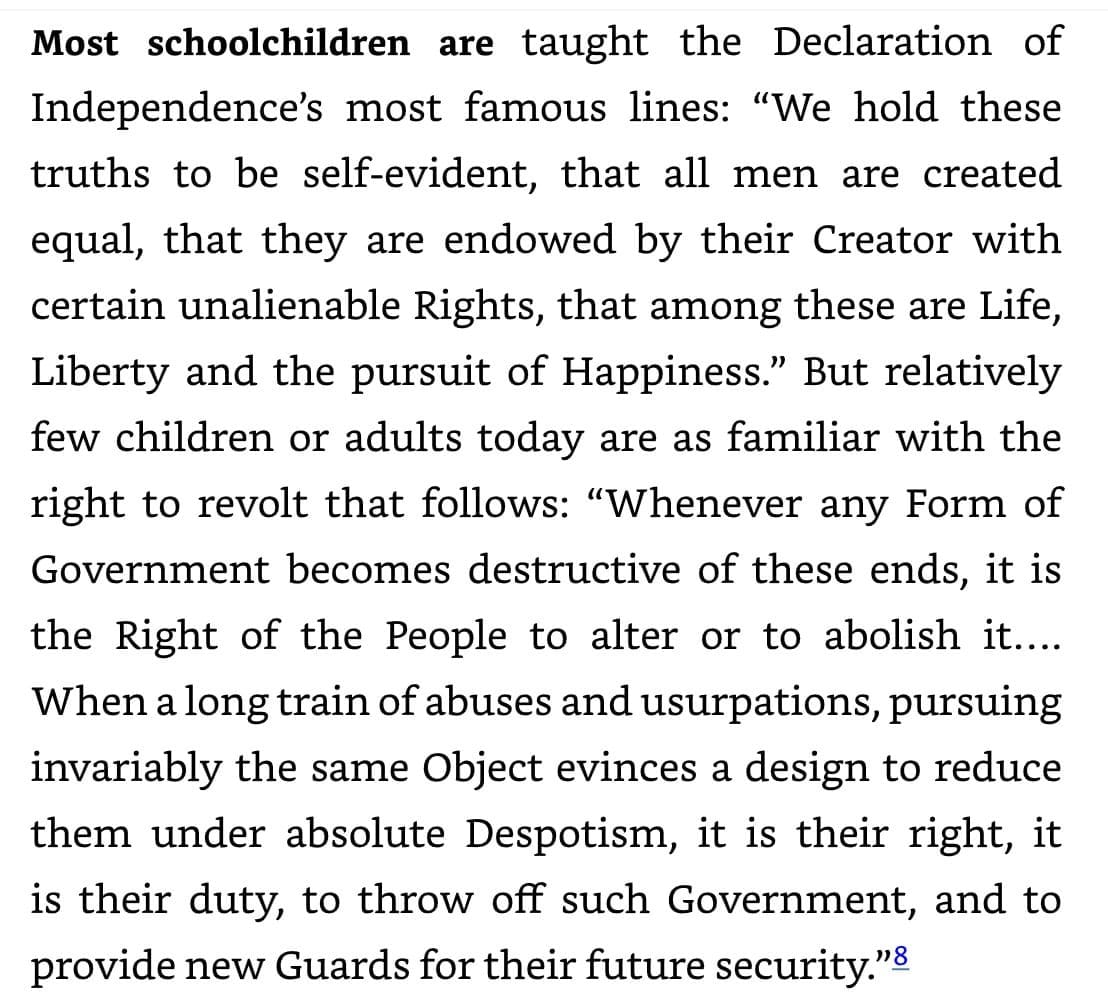
Strangely, both Inboden and the 1619 Project authors seem to be dancing to the same tune of "students aren’t familiar enough with the Declaration of Independence," an argument outside the scope of this piece (and my interests). Instead, let’s examine the dichotomy Inboden sets up with the conservative discrimination yarn and the "What is the Declaration of Independence?" story: on one end you find America’s founding principles, and on the other are "identity concerns," as Inboden refers to them.
"Identity concerns," worries Inboden, distract us from important questions like "what kind of ideas do we hold about justice, freedom, love, order, equality, government, God, human nature, time, the Good, the True, and the Beautiful? What do we believe about ourselves, our families, our communities, our nation, our world? How do we form social organizations and engage in collective behavior, whether cooperation, competition, or conflict? How should we think about this life and the possibility of the next life? Such questions are pushed aside in an academy dominated by identity concerns."
The argument here seems to be that by turning toward identity and away from important questions about, say, "time" and "The Beautiful," universities have iced out Joe Cellphone, who now doesn’t have as much confidence in higher education (and especially in the liberal arts) as he once did. Another pain point for Inboden is that "too many American history courses present the American past as a litany of oppressions and hypocrisies, leaving students with an imbalanced view of the United States." Because of this supposed slant in education, Inboden sadly concludes:
It is perhaps no coincidence that levels of patriotism among young Americans born from 1997 onward have reached a modern nadir. A recent Gallup survey found that only 41% of that generation say they are 'proud to be an American.' It is hard to love something you know little about or have only heard criticisms of.
Again, it would be one thing for Inboden to simply make this argument, but he errs in trying to prove it with statistics. The Gallup survey, if it is the one I think it is (Inboden does not deign to link) does note that only 41% of Americans are "extremely proud to be an American," though Inboden declines to mention that 17% are merely "very proud to be an American," bringing the combined total of proud Americans to 58%. Inboden connects this pride (or lack thereof) to what is (allegedly not) taught in history classes, making the claim that the corollary between not learning what America is and not being proud of it is "perhaps no coincidence."
It is not a coincidence (it is a grasping conclusion based on incomplete data), and I would argue anyway that it is less important that students are "proud to be an American" and more important that they learn historical and factual information about this country (since they are taking part in an education and not a parade). But Inboden has made his point, and then stacks up other champions of his worldview throughout his piece like Pogs.
One of these individuals is not an academic at all, but Palantir CEO Alex Karp. "Having witnessed the civic wasteland that a Silicon Valley bereft of transcendent values and meaning has become, Karp bemoans that America now lacks a 'thicker conception of belonging' based on 'a story of what the American project has been, is, and will be — what it means to participate in this wild and rich experiment in building a republic.'"
With the power of the artificial intelligence created by Palantir, this new republic is promised to look quite different, and barely has room for the liberal arts at all: "This technology disrupts humanities-trained — largely Democratic — voters, and makes their economic power less. And increases the economic power of vocationally trained, working-class, often male, working-class voters," Karp said recently. A "manifesto" Karp composed was also recently condensed into bullet points by Palantir. One of the 22 bullet points states that, while we’re currently at war with Iran, "American power has made possible an extraordinarily long peace."
Like the aims of the JMC, which prioritize Western thought and pro-American studies, we are seeing UT Austin lurch in a similar direction, beginning most notably with the consolidation of what were once several standalone departments in the school for liberal arts. As author Randy Lewis said in an interview with this website, "It took hundreds of people working for years to create Black Studies, Mexican American studies — and then more recently — women's and gender studies. Those departments being dissolved is an absolute slap in the face to those communities and those scholars who did great work in those units with great students."
This is just the beginning, but there is already a set precedent, in miniature, for what UT Austin will look like under Inboden’s tenure as executive vice president and provost. At the University of Florida, public money was promised to the Hamilton Center through Governor Ron DeSantis’s office. The legislation funding the school notes that it will "ensure Florida’s public universities and colleges are grounded in the history and philosophy of Western Civilization; prohibit DEI, CRT and other discriminatory programs and barriers to learning; and course correct universities’ missions to align education for citizenship of the constitutional republic and Florida’s existing and emerging workforce needs."
In an Inside Higher Ed article, Inboden was quoted as saying the work the Hamilton Center was doing was not "counterindoctrination," and besides that, was "pre-political." Is it? In his National Affairs article, Inboden makes the same point, extolling the virtues of these "new academic units," positioning them as "standing upstream from politics, eschewing partisanship, and instead heralding the pre-political academic ideals of discovering knowledge, seeking truth, and cultivating citizenship."
He may even believe that. However: in a January 2026 editorial for the University of Florida’s student newspaper The Independent Florida Alligator about the Hamilton Center (now called the Hamilton School), Sasha Morel writes that "The school’s funding mechanisms, professors and a majority of students beget and prioritize conservative American thought." Contrary to any formulation of "pre-" or even "post-", such a school can't help but be what it was designed to be — a wholly political project, and one that is fooling few people, least of all its students.
UT Austin is a big and varied enough school to encompass a wide array of classes on many topics, and the fact that certain departments have been marked for obsolesce only proves that it's not enough that Inboden himself dislikes specialized "identity" departments — their classes have to be unavailable to everyone. Inboden's ideal school will strictly promote the line that the West is as the best, idealism trumps materialism, and diversity is divisive. Both sides of "debates" will flatter power and prestige, limiting the "controversy" to questions like: John Adams Sr. or Jr.? Inboden’s favorite tech CEO promises AI will "destroy" humanities jobs, but there will always be grants for scholars ready to patriotically midwife a cold war into a hot one. This pivot ensures that the money will follow. With less and less "identity" departments, why not have more special schools/institutes fill the void? What if all of UT Austin was one big JMC partner organization?
My own memories from college (first at the University of North Texas and then UT Austin) include reading Plato's Gorgias, Felix Holt, the Radical by George Eliot, Filippo Tommaso Marinetti's Manifesto of Futurism, and so, so much more. As important as what I read was the function of the reading — being taught Felix Holt was not meant to indoctrinate students toward the proper mindset regarding the 1832 Reform Act any more than reading the Italian Futurists was designed to create fascists.
We did not read Marinetti's poetry because our professor wanted to turn us into devotees of Mussolini and fast driving, but to help us better understand political and aesthetic movements — and all in service of a better and more varied appreciation of politics and aesthetics writ large. To take such work seriously does not mean taking it aspirationally, and the introduction of (and ability to critique) a wide variety of work from various perspectives is part of what makes a liberal arts curriculum so unique.
Scholarship, in an environment like the one Inboden is working to create, will suffer. He imagines the ideal university as one which will teach "the best that has been thought and said" (quoting Matthew Arnold), with, I imagine, extreme prejudice against the wrong kind of ideas — he seems to have confused a liberal arts education with a very particular kind of greatest hits compilation. But that's just my perspective, which I've developed as a graduate of a public university. And not Stanford. Or Yale.
I'd like to end this piece with a bit of fantasy. In Jack Miller's children’s book, The Vision, a multicultural group of children are sitting in rapt attention as a man described alternately as "Pa" and "Grandpa" enthralls them with stories of saving tin foil for the war effort. The subject turns to the American flag, and then "Olivia, the granddaughter, says, 'We don’t have flags in our classrooms and we say the Pledge of Allegiance only once a week on Fridays at assembly.'"
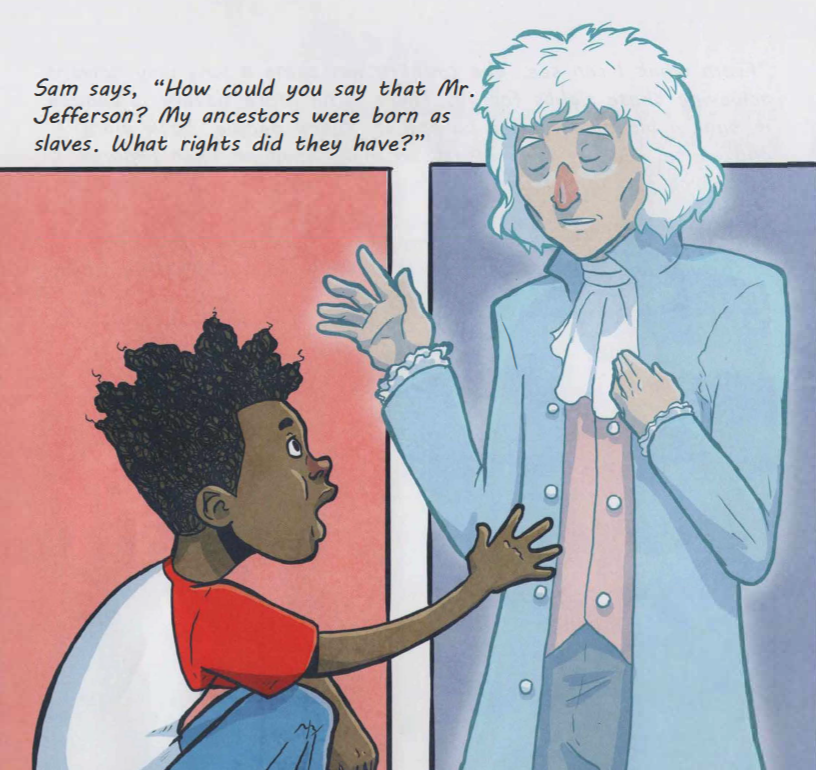
Later, the raccoon-eyed ghost of Thomas Jefferson appears. When pressed on the subject of slavery as it relates to "all men are equal" by Sam, a young Black boy, the ghost of Thomas Jefferson has this to say: "Young man, you are right. When I wrote those words, we had slavery in some of our states and even I owned slaves. I knew that it was a terrible wrong. And a few years later, when we wrote the Constitution, many states wanted to free the slaves, but other states refused to join the union if we did. So, we compromised with them just as you sometimes compromise when you can’t win an argument."
At Ronald Reagan high school, we stood for the Pledge of Allegiance every day, followed by a "moment of silence." The Texas pledge was added to the morning routine by the time my younger sister graduated from high school, and now the Ten Commandments can be forced into classrooms as well. But mandating the construction of the entire tabernacle onto every football field between home games will not solve what Inboden and Miller see as America’s "problems," because problems like a diminishing "academic social contract" aren't real, and therefore can't be addressed with any amount of pro-American penance. Besides all that, reciting the pledge or looking at the American flag is not forbidden in classrooms, and the history of American slavery is not like having an argument with a friend.
Real issues facing students at UT Austin — like the criminalization of protest, the drowning of academic programs, and the high cost of education — are barely problems at all to Inboden, but distractions, just nagging things in the way of the the financing of millionaires and a promise of even more public and private civics "partners." And if it all doesn't work out? There's always Florida. Again.