In and Out of "The Topsy-Turvy World of Jim Cartwheel"
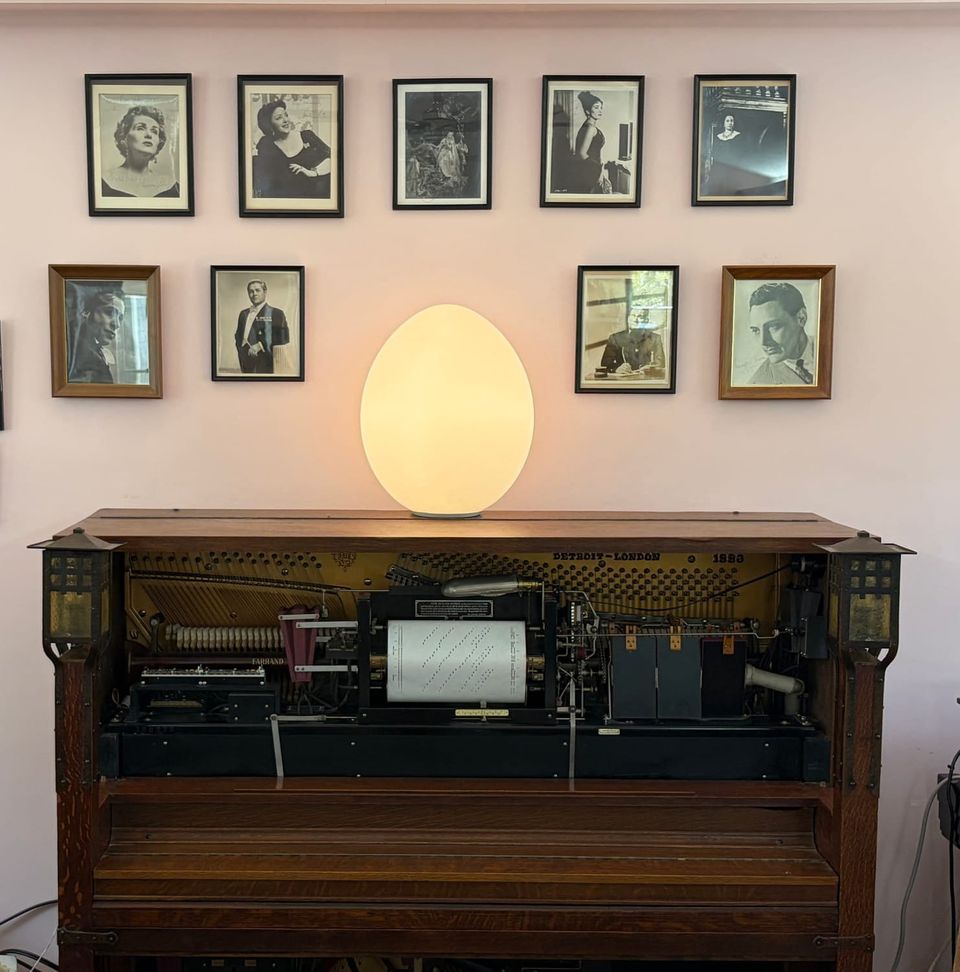
Immortal Performances is a museum/store/house of curios in a part of west Austin that, as far as I know, has no other museums or stores (and probably nowhere near as many curios). Information about this unusual, multi-hyphenate experience is scarce online, though there is this, from Yelp: "At Immortal Performances Classical Records Tapes-Compact Discs we care [sic] a huge selection of music. We also have one of the largest collections of Classical music. We carry a wide variety of new and used LPs, 45s, 78s, CDs, and cassettes. We are also an Antique Phonograph Museum. If you're looking for good products at a good price, this is the place. Please call ahead before visiting to make sure we are open."
I should have followed this last piece of advice, but one weekend my wife and I were nearby and we stopped over in the very residential neighborhood where Immortal Performances lives to see what they were all about. At the time, the house was hosting a few folks over for a movie, and we were asked to come back. A few weeks later I did, this time prepared to interview the polite man with dark-framed glasses who first answered the door.
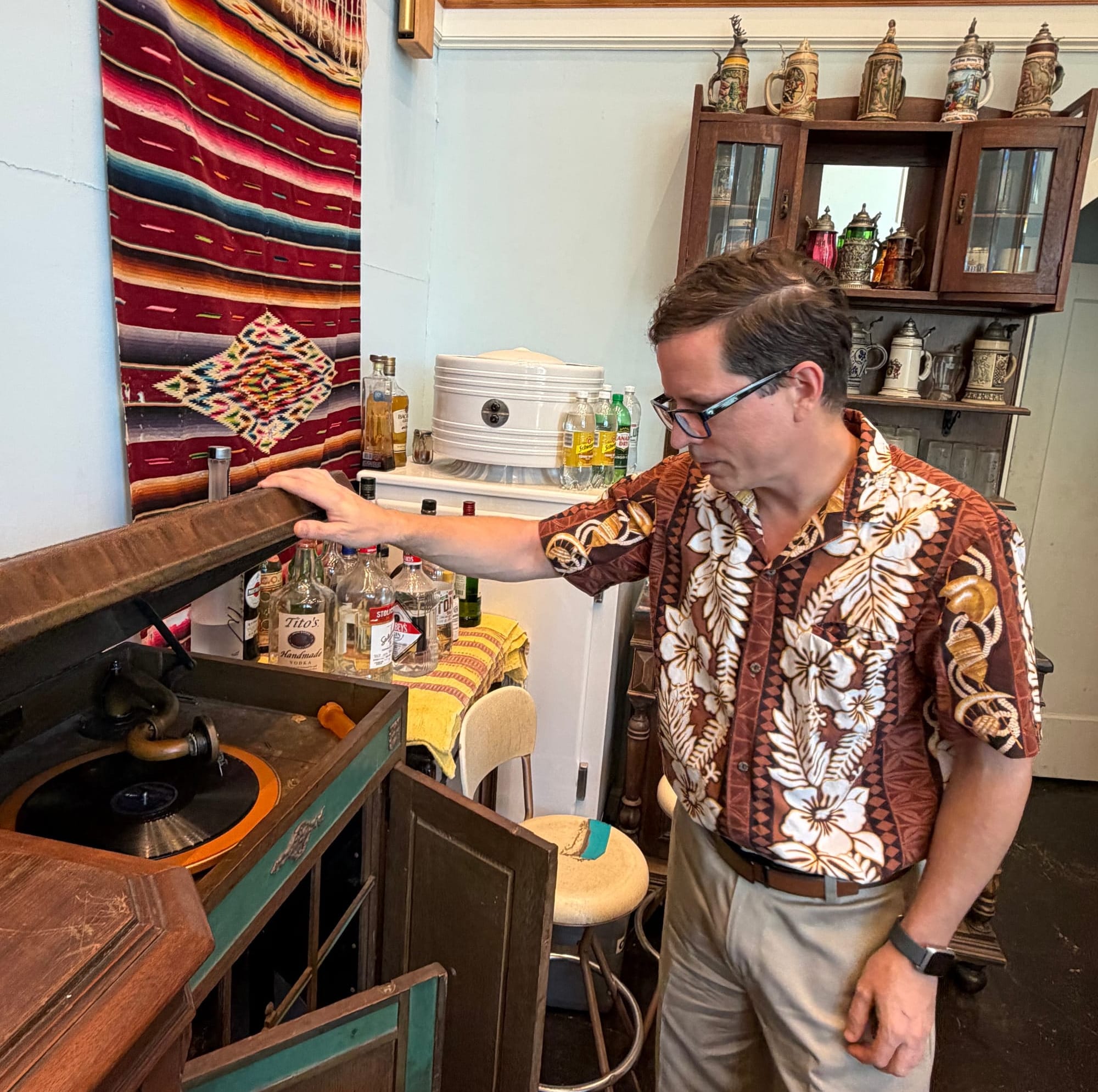
This person, John Cox, 48, is now in charge of the space and the many, many records and phonograph machines within. John worked with the founder of Immortal Performances, Jim Cartwright, for over twenty years until Cartwright’s death in December of last year at the age of 81, and Cox is now the executor and the primary beneficiary of Cartwright’s estate. In the early 2000s, Cox was studying cello at the University of Texas when a friend urged him to visit Cartwright’s store. "I was fascinated by the fact that Jim had a big section of his orchestral music categorized and alphabetized by conductor as opposed to composer," Cox tells me. "I bought a few records and started coming by fairly often. It was just a really weird situation, just in the middle of a residential neighborhood."
Early on in our conversation, John tells a story that explains how Cartwright — and the people around him — began to have an immediate influence on his regular (and creative) life. "Jim invited me to watch movies with a friend of his, and I said sure — we both had similar interests in movies. At the time, I was tired of the classical music competitive scene…I played the cello, but I'd kinda stopped playing it because I couldn't find people to play with for fun. It was just either going to school or being a professional. I went over there, and [the friend] was an amateur cellist and had two cellos hanging around the fireplace mantle in his living room area. We had drinks, and it was fun…I think [the movie] may have been one of Wagner's Ring cycle operas. Afterward, it came up that I played the cello, and so he said, 'Well, why don't you try to play something?' I played a couple pieces that I knew pretty well, even though I haven't been playing for a while. And there was a pianist in attendance at the party, and she likes to play music for fun, and so I started getting together with her. She was friends with Jim, and so I started playing chamber music 'cause she knew of some other people. It kind of renewed my interest in the cello."
Cox didn’t know that this relationship with Cartwright would grow and eventually encompass other roles: employee, business partner, caretaker. But to really understand Immortal Performances today, we need to go back to Jim.
In a Texas Monthly piece from 1983 entitled "A Chamber of Music," writer W.L. Taitte details a visit to Immortal Performances, describing the Bryker Hills neighborhood as "quaint" (it is now closer to "upscale") and Jim as a "tall, scruffily bearded man who is a little shy." Taitte reports that "Cartwright was born into a very old Texas family in Terrell 39 years ago. After growing up in Beaumont, he studied music at North Texas State University, but he got his degree in business administration. Later, after a hitch in Viet Nam, he started selling records on a small scale out of his house in Austin. In 1972 he adopted the name 'Immortal Performances' and added a mail-order business."
Jim "was the last in the line of the Cartwrights," Cox tells me. "They were some of the first pioneers and big landowners in Texas and Oklahoma. In particular, [Jim’s] great-great, or maybe great-grandfather, was the one that managed to make a deal with soldiers that would get a parcel of land for serving in the Civil War. They would want to go back home to the state that they were from, and so he would offer to — this is my understanding — take care of their property if they would turn over the mineral rights. And so, the Cartwrights amassed all these mineral rights. But Jim wasn't interested in being a business person in that way." Instead, he sold classical music.
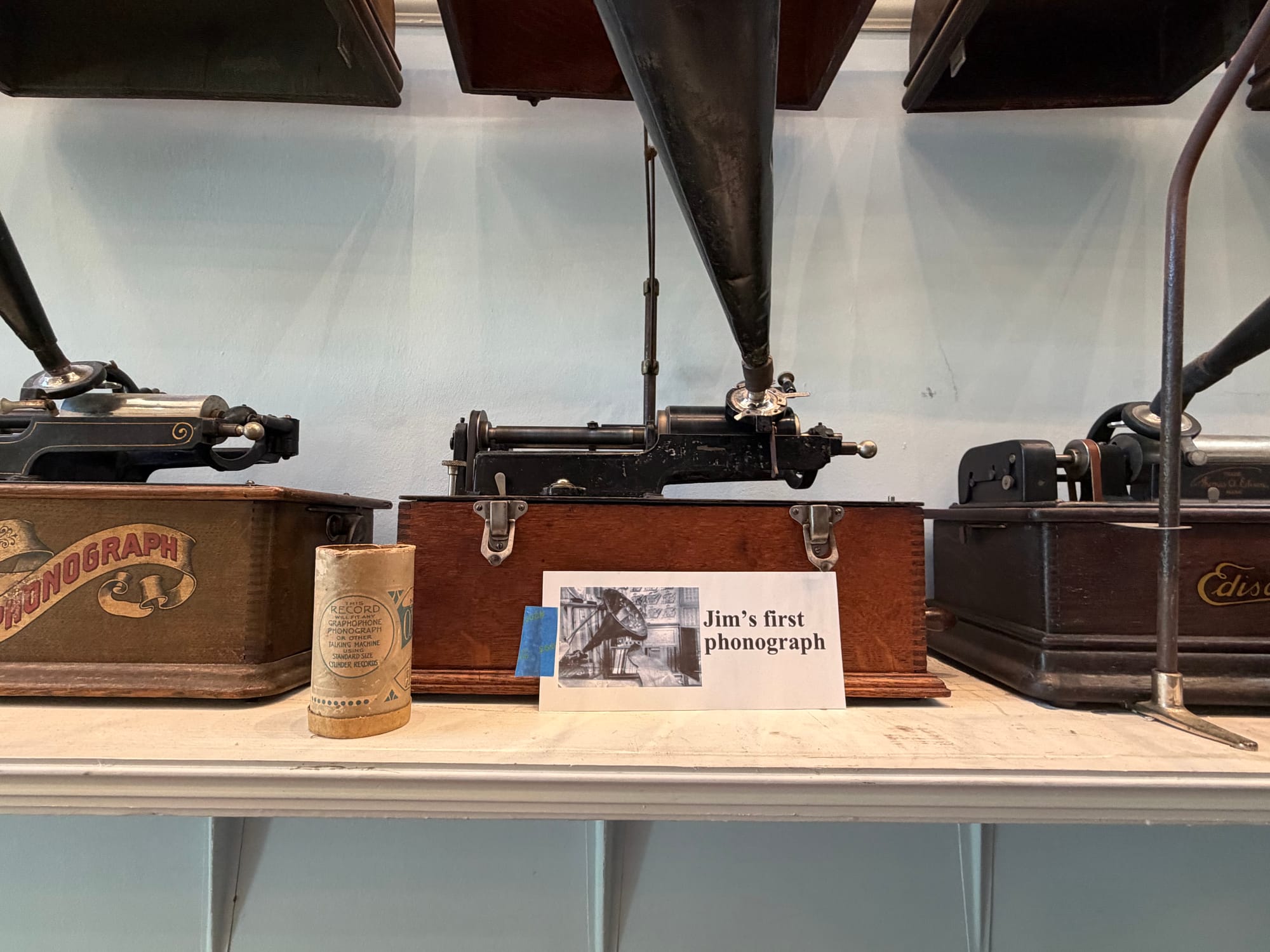
John tells me that Jim’s passion for phonographs and records was a "lifelong obsession. When he was eight years old in elementary school, there's doodles…he would be drawing phonograph machines on the sides of the paper. I think it was a great aunt…he went to her house at eight years old, and she had this, I think this machine here [see photo below], and he really coveted it, and it had something like 20 records with it. It's a Brunswick, and he could name all 20 of those records, like, clear as day. All classical vocal — that was kind of his biggest obsession, the classical vocal records. But he was hugely interested in everything orchestral, and I don't know, I wouldn't want to pigeonhole him because he loved piano music and orchestral, and he was even really into the Beatles."
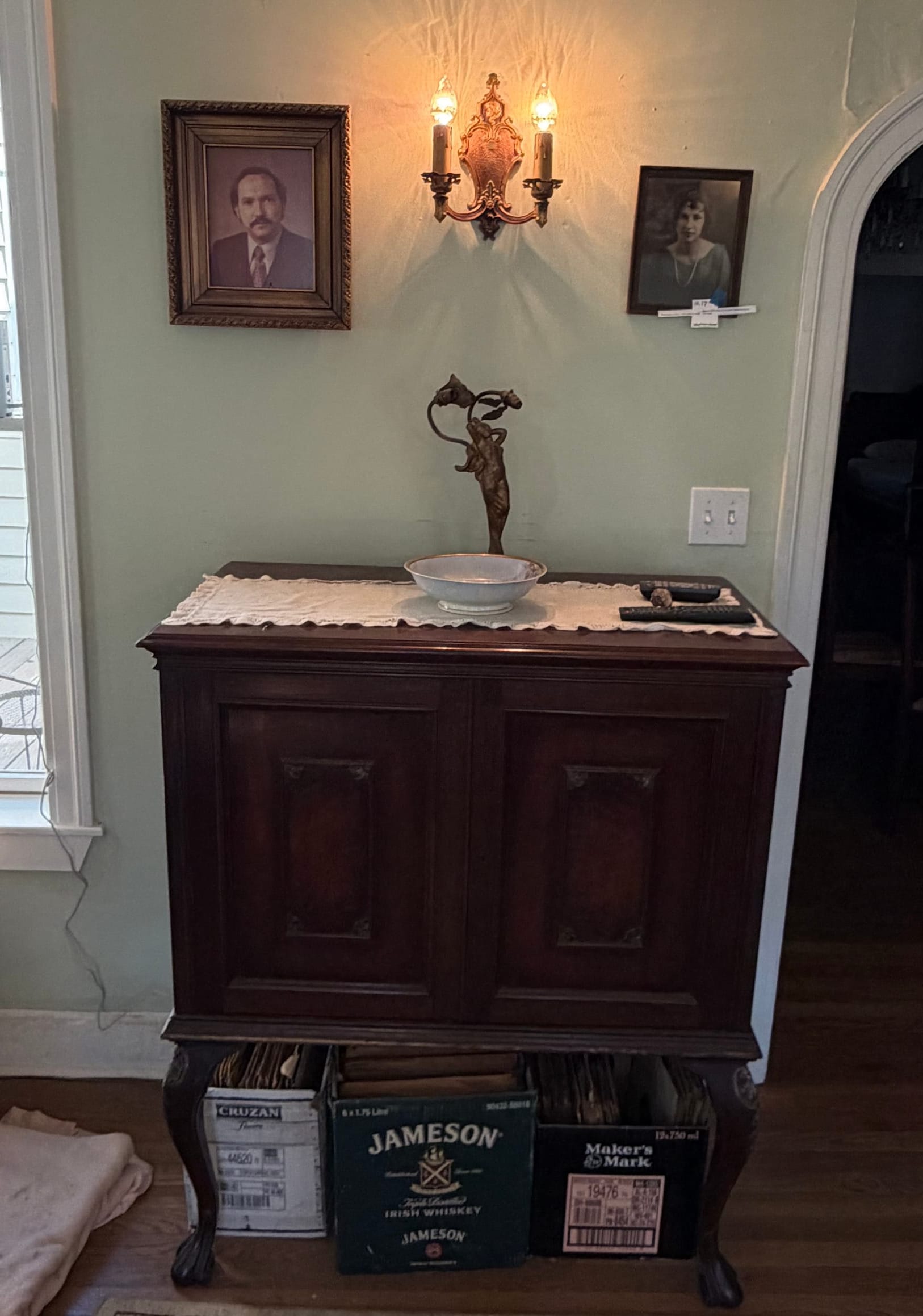
Twenty years after that Texas Monthly article, the number of records in Cartwright’s possession — then listed at 25,000 — had grown to more than four times that amount. At this point, the possessions that brought Jim such joy, and which made up his livelihood, were beginning to enclose him. "You could only literally open the door, like, maybe a foot and a half or something," Cox remembers. "He had so many records, and he saved everything."
To even get around the house, Cox says visitors had to find "little deer trails you could barely walk through. There was so much…and broken records everywhere on the floor, almost like a gravel." His friends jokingly called the ever-present mess a "sea of debris." Something would eventually have to be done about it all, but one of life’s two constants (death and taxes) sped up the process. "He was getting audited by the IRS," Cox recalls, quickly adding that it was all fine in the end ("he keeps all his paperwork"). And so, "He was in a tight situation and called me up and wanted to hire me to assist him in organizing everything and finding all the business papers. So I said, 'Well, okay.'"
Cox began working for Cartwright in a part-time capacity around 2002, and after three years the IRS situation was managed and the house was in a better place. But the records, and more, kept coming. "After the organization, [Jim] started entertaining the idea of putting an addition onto his house 'cause he owned the property next door that he would rent out." Cox recalls that "around 2009, 2010, he decided to do it...he owned a tree farm out in East Texas, near Louisiana, kinda around Houston. He sold that property and used the revenue to build the addition," which was finally finished in 2012.
Early in our conversation, Cox told me that Jim "had phonograph machines in over a dozen people's houses that were kind of fostered out that he had bought but he didn't have room for." Now, those machines were coming home, along with even more records. "We went to over a dozen people's houses and picked up the different machines," said Cox, adding that "this whole time he's running a record shop in the back, and half the time I'm attending to customers, and half the time he is."
Cox also learned that "Jim also had two storage units in town, and one of 'em was, like, dirt floor. There were possums living in it. Like, it was a crazy situation. I cleaned out those storage units, and we realized there was a lot of water damage to thousands of 45 RPM records. All of a sudden I was bringing trays and trays of 45s home with me, and then I would meticulously clean 'em. Jim was very meticulous, and I was always on edge. Even a little phonograph needle that had already been used up…if I would find it on the floor during this entire process [and] if I would throw it away and he would see that, he would feel obliged to go through the entire trash can and see what else I might have thrown away that might have been useful to him."
During the messiest years, the state of the house was a health hazard as well. "The kitchen in there, there were rats, like living around everywhere," Cox says. "It was kinda sad. He would spend a lot of money buying some precious, beautiful old antique, and then it would get put in this environment." Even the way the house felt was tuned to Jim’s particular frequency. "Air conditioning, another example," Cox remembers. "He would hardly ever use it, even in the hottest part of summer. It'd be 100 degrees outside, and it would be cooler outside because at least there's a breeze."
Cox traces the beginning of the real problem to the late nineties, when Cartwright’s stepmother died and left him some money. "He didn't get any of that [Cartwright] money until much later, in his mid-40s. I think he did have some, but it wasn't very much. According to a guy that worked for him before me that I'm friends with, that's when he started buying more [records and phonograph machines] than he could house." Even as Cox worked to make the house more livable, more surprise visitors kept arriving for good. "There was some storage in Beaumont where his parents lived and had been there since the mid-'90s. All of a sudden, a couple of full-sized truckloads drive up with all this old furniture that had been in storage for 20 years…all that came in and kind of before you know it, he filled up the addition. And there were always records coming in that he would buy from auctions."
Jim was aware, even way back when, that his organizational skills were not ideal. In his piece for Texas Monthly, Taitte writes: "'Don’t set anything down,' warns Cartwright. 'The house swallows things.'" In addition to the aforementioned "sea of debris," another nickname — this one for Jim’s bedroom — was "Schwann Lake," due to the amount of Schwann catalogs on the floor acting as an accidental carpet. Jim came up with the self-deprecating moniker "the topsy-turvy world of Jim Cartwheel," though that world had a tendency to spill over into those of his friends and colleagues.
One quick and illustrative story: John tells me that Jim’s friend — Butler School of Music professor Gergory Allen — no longer had a certain record of his own playing. Jim did, though, and it was only a matter of finding them (John heard this story second hand). "There was this big mound of records towering up in the living room," John tells me. "And Jim said, 'Oh, they're in here somewhere.' And so…Greg actually had to fully spread his body out on the pile, and Jim was holding his legs while Greg reached in and was able to get some of the LPs, and Jim pulled him out of the stack. I guess Greg successfully got the records, but it was just a wild situation."
About five years ago, Jim got sick. "I took care of him," says Cox. "I didn't realize I was going to have that kind of a job, but he needed the help. We would convert the living room here into a bedroom for easier access to the kitchen and a bathroom over there. And he got like 100% better from that." And as much as he supported Jim, John did feel conflicted about possibly encouraging his friend and employer’s more damaging tendencies. "For decades with Jim, what we would…he would do — and I would kind of enable — is he would buy a large collection and then just put it in storage. But all these rooms would just become storage areas after time went on and more records would come in, so [the rooms] would become less and less functional."
Jim died in December of 2025. "It was unexpected," remembers John. "He was in good form but broke his femur and just had some complications in the hospital and died from it." After everything John had told me, I assured him he must have been a great source of support for Jim, especially in making his house a better (and safer) place to live. And in return, Jim inaugurated John into a community of classical music lovers, and rekindled John’s love of playing for fun.
John still plays for fun. His group the Shady Pines Chamber Players perform in a village called Cloudcroft, (the Christmas Capital of) New Mexico, every summer. He also has big plans for the Immortal Performances space, which is now clean, light, and spacious — I notice that in the library, the books are even organized by topic (“Anthropology,” etc.), thanks to John’s mother (note: John's sister, Katy Rose Cox, is also a musician, and plays the fiddle in a group called Tiger Alley).
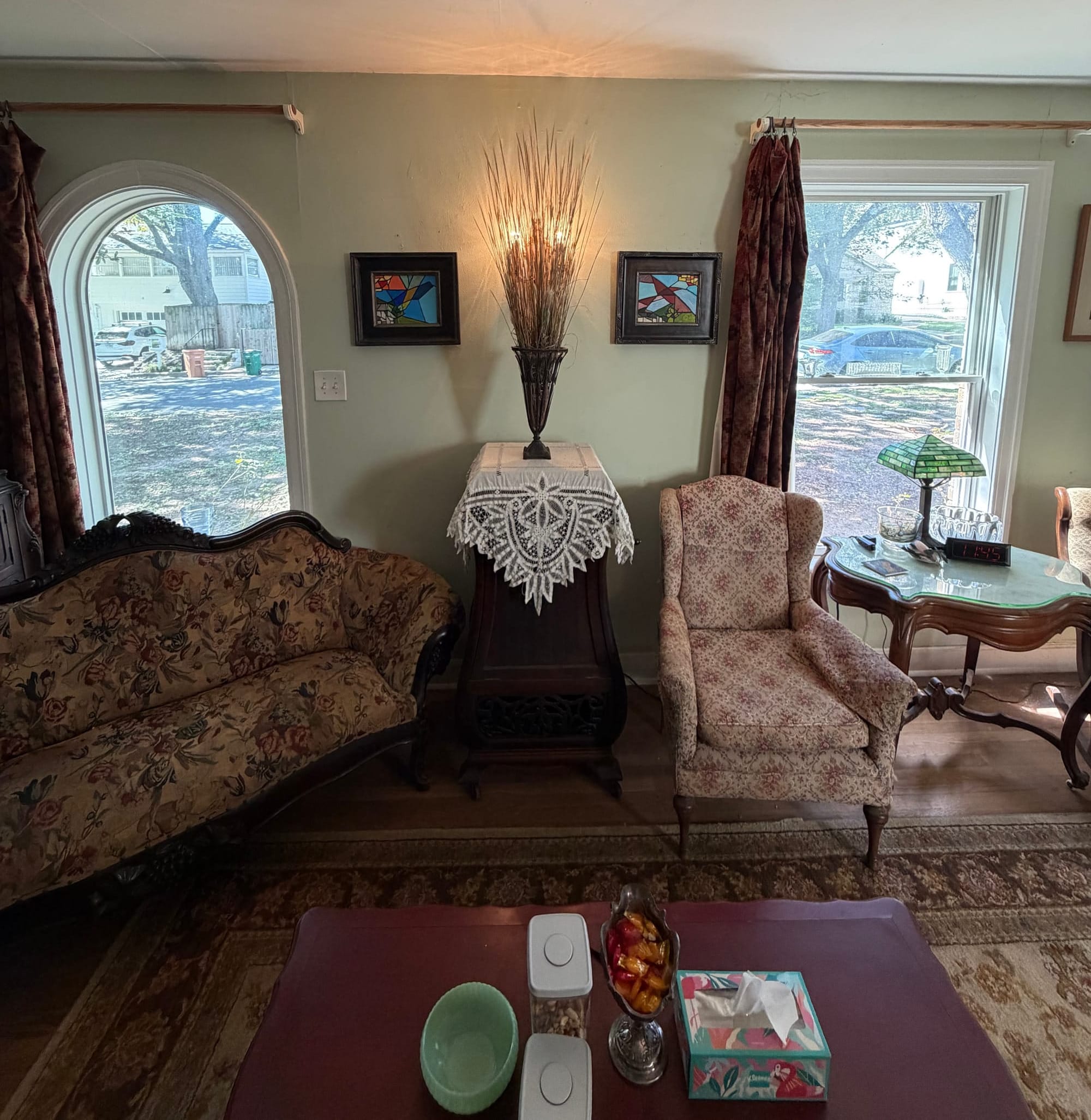
The living room is filled with austere furniture, old photographs on the wall, and — of course — phonograph machines. Walking into the house, you can see another row of phonographs on display in a corridor right past the front entrance, with a staircase twisting up behind it. Later, John will guide me through some of the treasures the space now holds.
John is still working to settle Jim’s accounts and to consolidate — he decided to close down a stall the business had in an antique gallery in Round Rock, and plans to end the storefront part of Immortal Performances soon. Stepping into the place of this direct commerce, John hopes to facilitate the area as something closer to a museum, featuring occasional performances/gatherings — changes that wouldn’t surprise his friend and old boss. "Jim figured I'd probably sell some of the phonographs or figure out a new home…what I'm trying to do is make it more like a functional space, but keep the majority of the collection," says John. He estimates they have 20-25 machines in the home right now, and over a hundred thousand records.
One gathering John hopes to host soon is something called the Musicale, which he describes as "a gathering on New Year's Eve of a bunch of musicians, classical mainly," who "get together and celebrate the new year and play lots of music and have libations." John says they haven’t had the Musicale since the addition was put onto the house. He has lots of plans for Immortal Performances, and beginning 2027 with the Musicale seems, to me, like a way to welcome the future while honoring the past.
More on Immortal Performances from Dylan Blackthorn, Martin Theophilus, and the Texas Archive of the Moving Image.