Living In and Maybe Escaping "Bummerland" — An Interview with Randy Lewis

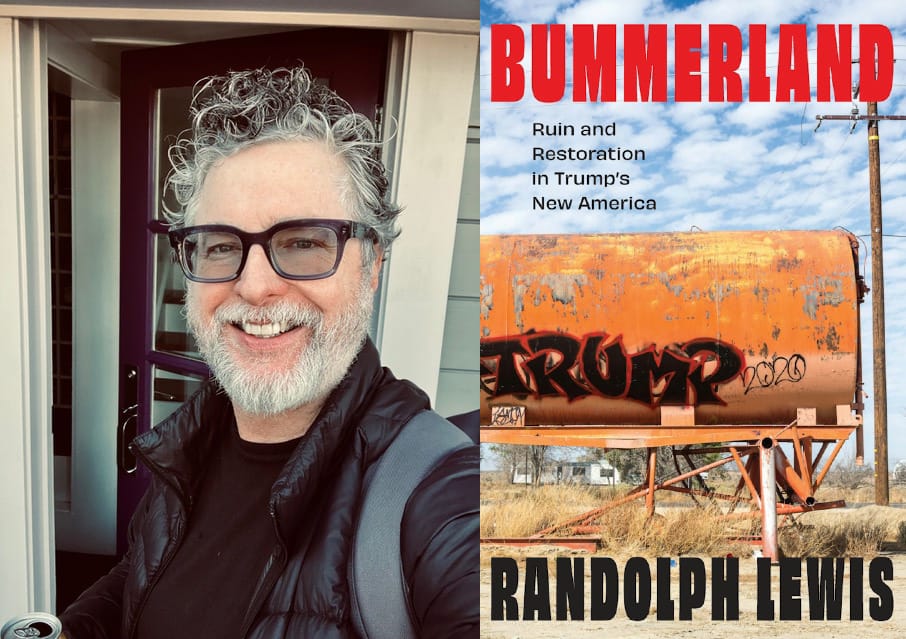
I first became aware of Randy Lewis, a professor at the University of Texas at Austin, through a publication he edits called The End of Austin. Finding the site's title provocative and the "About" section irresistible — "If you have something to say about Austin’s shifting identity, please let us know" — I went ahead and shared my thoughts on Austin, which the site published. Grateful and curious, I emailed Lewis to ask what else he was working on, and almost two years ago exactly he told me that he was working on a book called Bummerland.
Later, Lewis shared the galleys of the book with me, and over the course of 35 essays, I experienced the author's personal unraveling during the pandemic and first Trump term, alongside the adventures and reflections required to pull him partly out of the darkness. Along the way, the reader travels with the author out of Austin and to Selma, Las Vegas, Uvalde, Mexico, and even Norway. There's an arresting chapter about chronic pain, though Lewis also takes us through less harrowing avenues of self-discovery and, at the end, leads us to guarded optimism. Bummerland is out March 3rd, and Lewis was kind enough to make The Austin Tadarida the first stop on his promotional tour.
In Bummerland, you write about how your approach here differs as compared to your previous books. Can you talk about why you decided to write about your life in a way that was less academic, and more personal?
Part of it was the pandemic and the fact that I was in a writing group with six people who are really extraordinary writers, including Lauren Berlant and Katie Stewart, and watching the way they responded to contemporary events and processed things. They always filtered things through personal experience — the result is like a chocolate thumbprint on the page. There was a real personal touch and it didn't feel abstract, or like academic writing that was for a journal. It felt like something coming from the heart. And I see both of those women as poetic writers who are philosophical and literary at the same time, yet they're doing cultural studies work in anthropology or English. There's something very poetic in this mode of writing.
I've always had one foot in the creative world and one foot in academia; I was always kind of a square peg in a round hole when it comes to the norms of academic production. I did it well enough so that I could stay within academia, but I did it begrudgingly. I didn't really think the world needed, ever, another article on whatever topic, behind a paywall. And so my role models are — going back to when I was a kid — Hunter Thompson and Joan Didion and people who wrote for broader audiences coming out of journalism. And now, later in life, these academic writers who have a more poetic and personal voice.
So that was a huge inspiration. But I think the other part of it, Adam, is just necessity. And hopefully your life hasn't been crazy and brutal to the point where you feel compelled to write in a certain way. But the last ten years just did a real number on my brain because I internalized so much — despite all my privilege as a straight white guy — I internalized a lot of the suffering at the national level and the discord. It just really unsettled me mentally and emotionally in a way that I wasn't prepared for, and that I didn't feel during the Reagan years or the Bush years.
There was some kind of sharp stick in the eye impact to the Trump years for me, personally. And it really encouraged me to think that through, to try to write about that experience and to wonder, you know, like if it's hitting me so hard — a guy that has a steady job with a little bit of job security and not one of the marginalized, vulnerable people in this country — if it's hitting me that hard, how hard is it really, out there? It was a sobering thought, and that's how I got into this mode of writing where I'm the crash test dummy. I don't see it as a true memoir where you really learn a lot about my life, but I'm the crash test dummy between different cultural forces. You know, I get ejected out of the Volvo [ejecting noise] and I write about the way I hit the ground, basically.
Your descriptions about your health issues are harrowing not just because of what you experienced, but also because our health care system seemed at times indifferent or simply unavailable to you. For our readers who don’t know, can you talk a little about what you went through, and how writing about your health has changed and maybe helped you get through the worst of it?
Most of that's in a chapter called Healing Inc., and what I realized was that I was living a version of a story that many, many people in America feel and go through....but that people don't go through in most wealthy countries — this experience of extreme indignity and precarity and almost bankruptcy from the medical debt and the medical chaos of a capitalist medical system. I found myself in an unusual position because I was dealing with neurological issues that just kept cascading through my body and then becomes chronic pain. And I didn't know anything about chronic pain before my fifties — and I'm 59 now — so I'm writing this book during a period where I'm struggling just to stay alive every day, because the pain is so intense that I can't sleep and I can't sit down many days. I can't even walk sometimes.
What I'm doing then in that chapter is trying to track what it means to be a relatively privileged American with "good health insurance," quote unquote, and dealing with a difficult to diagnose and treat condition. I go through all the standard medical interventions and show how destructive and inhumane they are, of these doctors who perform hand surgery…they wanted to do it twice. They did it once for me when I was misdiagnosed with carpal tunnel in my hands. And I went back and I'm like, "The problem never went away after this painful surgery." And he said, "Well, we could try to do the surgery again because for me, I'm just a hammer and everything looks like a nail." And I thought, well, that's American healthcare, a guy who's the top hand specialist in central Texas who has nothing to offer — no listening, no touching of my hand when it's in pain — just this message of, "Well, we could try the thing that didn't work again, because that's what I was trained to do."
I went through all the standard things, but I also went through all of the alternative healing possibilities. Every single thing I could find. And I went into all of these with a really open heart, because part of healing — especially from anything like pain, which has a psychological component — is that you have to have some level of belief that this might help you. You can't be a total skeptic at all times, I don't think. And so the way I was exploited both in the alternative medical scene and in the mainstream medical scene, I thought, "Well, I don't know if I've ever seen anyone chart this before."
I didn't know I was writing that story for a while. At first, it was almost like medical journaling, just trying to figure out: "How do I describe chronic pain? How do I describe something that colonizes your brain in a way that you're not expecting?" Like there's nothing in your average life, if you don't have pain, that can prepare you for the way that it colonizes your consciousness 24/7. You wake up in the middle of the night and it's there — it's like a demon, if you wanna go in that direction.
It has a huge psychological impact, dealing with a lot of medical stuff. Losing all this money to it, feeling so scared and going through treatments that make things worse. And then, it got to the point where I was just so depressed and anxious from the pain — pain obviously makes you anxious — that I almost, I couldn't go on. It was very difficult to keep going. And I thought, well, that's kind of a metaphor for the country in 2020 or 2023 when I'm writing this. At this point, the metaphor for the country might be more like suicide.
In Austin, you visited two essentially walled-off mega-employers. What impact would you say both companies are having on not just the reality of working in Austin, but also culturally?
Yeah, Apple, I feel like I lived with them more superficially, and I only got inside the campus on that one day ["The Super-Hyped, Ultra-Rich Technopolis of Despair"]. I write about [the Apple campus] as a kind of Vatican for the tech world, and it was really revealing about the strange prohibitions they have against selfies and the tasteful but still very ostentatious wealth that's on display, and privilege and power. And then you think about Tim Cook going to the Melania premier and kissing the ring of Donald Trump, and that's who they are. You know, they're the not-paying-tax, deferring-to-authoritarians, but somehow then out of the other side of their mouth, they talk about diversity and creativity. And that's always how Apple products were sold, you know, "think different." A picture of Einstein. And now it's think with compliance and it's a picture of Orwell. I really resent that. And if Tim Cook can't say something dissenting to the people in charge, then who can?
What is the point of wealth if you can't tell people to go fuck themselves, really?
Absolutely. I just don't understand it. Like what is he holding it back for, other than another 2% of stock market valuation?
Probably that.
Now, Elon's a different story, because I've had an ongoing project that I think we've talked about called Elon Magazine and this GIGACITIES COLLECTIVE, and we're doing another issue now with a lot of contributors. So I think about Elon as…he's emblematic, in a sense, of this incredible takeover of our financial, political, and cultural space by this PayPal mafia and assorted tech criminals like Bezos. And I find their arrogance…you know, there's nothing they're adding to the Austin scene that is positive, other than I'm glad some people have jobs that they might not have had otherwise. But the quality of those jobs is hard to judge because they're so secretive at the Gigafactory, and who wants to live in Snailbrook, because the moment you say something against Musk on social media, you're gonna lose your job and get fired, and then you have to leave Snailbrook as a company town.

Musk’s energy is a really toxic thing to have in this place. Austin used to have a sweeter quality even to its capitalism. I don't feel any fondness for Silicon Hills and the vapid tech bro version of Austin that has been ushered in thanks to Apple and Tesla and the other Musk companies, I feel no gratitude towards them. They've done nothing for Austin that I consider important. Even the robber barons 120 years ago would create Carnegie Hall and great libraries. We have nothing from Elon Musk other than a self-interested population center research grant, that $10 million that was given to UT, to push Musk’s barely disguised eugenicist research agenda. I am really disheartened by the role of Musk and the other tech bros who think they understand something about the world and what's important for the rest of us, but they really only understand self-interest.
Let’s talk about your experience teaching at the University of Texas. Do you feel more pessimistic about higher learning than you have previously, at least in terms of institutional support? How do your students tend to think about their futures in Austin or beyond?
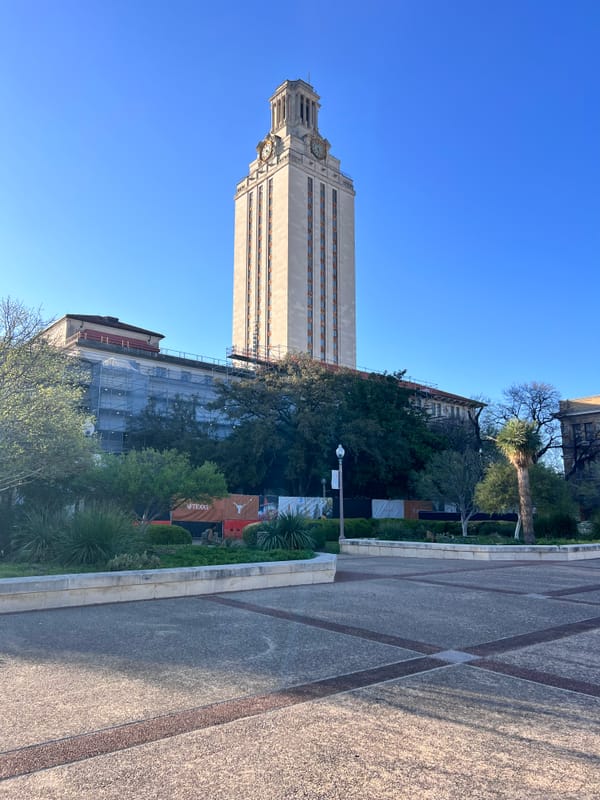
I can talk about the story of UT as a really great flagship university — in the 1980s and 90s, it was really on the heels of Berkeley and Michigan as one of the so-called public Ivies. But it has retreated into a kind of ideological anti-intellectualism, and this is playing out in dozens of ways across the university. In the last ten days, the university announced that they would cut and "consolidate" Black studies, Mexican American studies, American studies, and women's and gender studies — among other programs. It is a way for them to simply provide the optics that the governor wants about sweeping away the “woke" and hiding it somewhere---or crushing anything that would give pause to the average Trump voter.
And those cuts are really ironic at a time when they're building a School of Civic Leadership, which is designed to be the much more conservative version of the College of Liberal Arts. It's a duplication of well-established departments like philosophy, government, History, and American studies. It's a complete duplication of what we already do, but with ideological control that connects the governor's office to the classrooms. The fear is that they will only want faculty who are 100% gung-ho about American exceptionalism and don't have anything critical to say about extractive industries, because capitalism is always good and the market is always wise.
That is what's happening at UT. It took hundreds of people working for years to create Black Studies, Mexican American studies — and then more recently — women's and gender studies. Those departments being dissolved is an absolute slap in the face to those communities and those scholars who did great work in those units with great students.
It's a disgrace intellectually; it has no it rationale other than politics; it doesn't make sense economically, administratively, or intellectually. After the consolidation, the next step is that the university is going to be reviewing and policing the content and speech in our classes with a new level of scrutiny. Everything that's going on now is designed to get the university and its students, staff, and faculty in line with Trump administration priorities. And that's what Greg Abbott and Dan Patrick want. It's the antithesis of the liberty that they somehow speak about. It’s a repulsive kind of hypocrisy to me.
You also ask if this makes me pessimistic about higher education. Not entirely. The private universities that haven’t complied with Trump administration demands — like Rice University — they seem like they're holding their own. They are offering pretty much what they were offering five or ten years ago. At least that’s my superficial impression just from visiting campuses. So that gives me a little bit of hope. But the dismantling of the independent thinking that made UT great — trying to nullify that spirit of critique takes us back to the firing of UT President Homer Rainey in the 1940s or the McCarthyite purges of the 1950s. It's very depressing for faculty, and everyone wants to leave.
As for students, it depends on what level. The undergrads are a little uncertain and maybe not getting the full story yet. They're kind of surprised and sad when I talk about the cuts and seem like, "Why would they do that?” It makes it hard to actually teach about it, because that would require violating the new spirit of compliance. On there other hand, the grad students are really savvy to all of it and often very scared about what it means. Will they be able to graduate? Will we even have graduate students in the future, or is this the end of decades of graduate training? What will we be allowed to teach in this new unit? I mean, it's the first time where we have to ask ourselves, "What are we allowed by the state to do in the classroom or in our research?” The party of small government has now encroached so far into my life in so many ways that now they're inside my classroom, and inside my mouth.

Could you talk more about what it means to live in "Bummerland" to you? The phrase is dispiriting, but could be worse — "Tragicland" or "Sadland." What would it take to get to the "restoration" mentioned in the subtitle of your book?
There's a little bit in the last chapter ["Unobtanium"] that spells out what my vision would look like, but I intentionally kept the book from being too didactic or programmatic, and rather than speaking at the level of policy — which I'm certainly no expert in anyhow — it's more pitched at the level of affect and almost what I call texture, the texture of life in this crappy moment in history, in this country, that's sunk into what I call "Bummerland." And it's a grim state of affairs, but I do think that there are certain kinds of attunement to the suffering and ways in which we can re-narrate ourselves and our role in history, our role as Americans, and what America's role in the world is that would be incredibly liberating.
We need a new narrative. There's that great moment where the guys from Peep Show are dressed up as Nazis, and they're joking around and they suddenly realize that they might be the baddies. We're not the baddies necessarily, but we're certainly not the mythic white hat cowboys that we've been indoctrinated to believe. I think freeing ourselves from those damaging, limiting mythologies, freeing ourselves from the kind of cheap hucksterism that Trump is able to offer [...] I think that kind of attunement allows us to feel something closer to what Walt Whitman would imagine a democracy offering, which is a kind of adherence and connection and communion with one another. And that the people who are unhoused on the side of the road up by the Apple headquarters are not a distinct species separate from Tim Cook and Apple, or me, either.
That interwoven quality is what's lacking. And, you know, social media and these other forces are conspiring…I think it behooves billionaires for us to all squabble among ourselves about small cultural issues. I'm not sure Bummerland will teach people how to be attuned in that way, but there are ways of stopping, pausing, and reconnecting with our — I’m almost kind of sounding like a hippie here — deeper humanity and just allowing ourselves to feel the agony of the present as a way to springboard to something better.
Finally, can you talk about what plans you have for promoting the book in town and elsewhere? Where will your book be available?
The best place to get it is from the publisher, which is the University of Nebraska Press. They have a great website. It's one of their Bison Books, which is a trade book. It's still a university press book, so they don't have a million dollar budget for promotion, of course.
I'm going to try to do some events and book signings here and on the coasts in March and April. And normally with a book like this, I would do, hopefully, NPR and other kinds of podcasts and radio spots, just talking about Bummerland and what it means to have written this book. I hope people see it as a piece of writing that feels original and real. That’s all I can hope for.