"This is Our Land" - Writer Lauren Hough on Dogs, Data Centers, and Connecting Offline
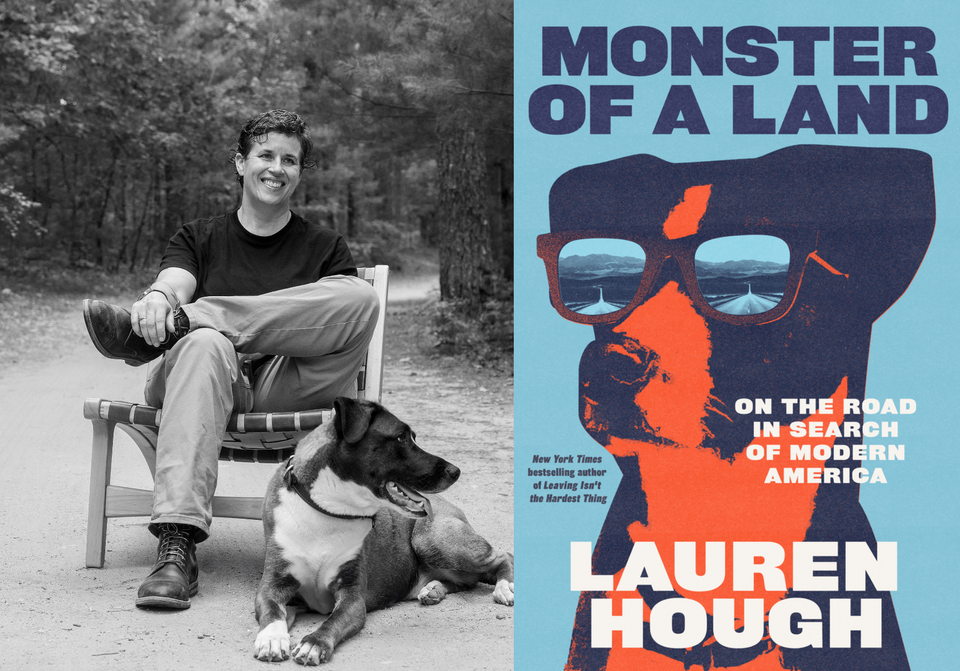
Five years ago, an Austin-based writer named Lauren Hough released a book of essays called Leaving Isn't the Hardest Thing, featuring subject matter alternating from remembrances of growing up in a cult to working around a "mummified cat" as a cable guy. The book was powerful in both content and the telling — Hough has a voice that is droll but not cynical, and expressive but never distracting.
Monster of a Land: On the Road in Search of Modern America is Hough's newest book, out June 16th. Exploring America by van along with companion Woody Guthrie (her dog), Hough lit out to see the country John Steinbeck described in his book Travels with Charley, only some sixty years later. Hough reunites with old friends and neighbors, encounters strangers ranging from the taciturn to openhearted, and is even (lightly) harangued by a "retired" psychic.
On Monster's release date, Hough will be appearing at First Light Books for an author event featuring her friends (and fellow Austinites and writers) Lucas Schaefer and Greg Marshall. The Austin Tadarida spoke to Hough about many things in anticipation of her book release, including the deadening effects of social media and finding hope in rough times. And about dogs in grocery stores.
Before reading Monster of a Land, I did some research by picking up Travels With Charley for the first time. As you note in your book, Steinbeck exhibits what I would call...strange behavior toward his dog, like being disappointed Charley wasn't impressed by or didn’t respect the California redwoods enough. What have you noticed about how attitudes regarding dogs in general have changed since Steinbeck published his book, and what accounts for that difference?
I think there's definitely an age factor — age plays into it for sure. I mean, the way my dad looks at a dog versus the way I do...like my dog is as close to my child as it can get. My generation and after, we throw birthday parties for our dogs. And they just didn't. A dog was a fishing buddy for sure, but also just kinda lived in the backyard. Although now my dad's wife has a dog who lives fully in the house, but is still not allowed on furniture, so.
There’s a generational divide there — and there's a social divide depending on where you are in the country. In more rural areas, the dogs are farm dogs, and they're working dogs, and they're a tool of the farm. But you come into downtown Austin and, well, you see all of us with our dogs that we all got from Austin Pets Alive!, and they all have their own monogrammed water bowls. I think it just depends on where you live, and where you're from, and probably your generation on how you see them. Steinbeck says that he throttled Charley in Yellowstone for barking at bears. And it's unconscionable to us now, but in that day and age, that's just...you throttled kids, too. Different times.
Since we're talking about dogs right off the bat, and you mentioned Austin…I feel like if I wanted to write something truly, upsettingly viral, I'd dive into attitudes about dogs on leashes versus dogs off leashes. Because you'll sometimes see people who say, "My dog doesn't need a leash," and other people will say, "Well, my dog does, and if your dog is off leash and comes up to my dog, there might be a problem, and I'm doing my part." Do you have any basic parameters regarding dog ownership? People get upset about dogs being in H.E.B., for example.
I think it's just our social contract in general that your dog shouldn't be bothering other people, shouldn't be bothering other people's kids, shouldn't be bothering other dogs. I used to walk a dog named Teddy who was an Akita, and he would take a bite out of a dog if he possibly could. And he didn't just do it for no reason. But if a dog tried to hump him…he would bite. He would fight back. So it was always really nerve-racking when dogs ran up to him, and people would be shouting, "He's friendly!" But he [Teddy] was not.
I'll let Woody off leash if we're out at a lake in the middle of nowhere and no one's around, or if we're on a beach and everybody else's dogs are running free and having a great time, and there aren't people sitting there having picnics on a beach...because he's definitely gonna go try to get a piece of pizza.
I think it's basically our social contract. You don't play your music so loud that it's bothering everybody after 10:00 PM. You don't let your dog run into other people's houses. And yeah, I don't know why there are dogs in H.E.B. Dogs don't even want to be in H.E.B. Every time you see one, they're slipping on the floors and kind of miserable.
I agree. And there's not a lot of treats for them in there for obvious reasons, and yet the place is filled with food. Now, let's talk about you a little bit. You had this big goal to see America by van, and then you made sure that when the opportunity came up, you did it. Since you’ve accomplished your goal, has it changed how you approach opportunities — either those that make themselves known to you, or those that you actively try to make happen?
I mean, everything that comes to me now feels like an opportunity, really. Whether or not it's the right one at the right time is a whole other question. But I get to live this life where I write books, and I take field trips for a living, and I tend to say “yes” to too many things, and then I don't have time to do them all.
I lived the life of just desperately waiting for the weekend and then being too tired on the weekend to do much of anything — working, you know, very physical jobs. And now I get to write for a living and everything. It all feels like I get to…going to a museum is my job, and going to drive around the country with my dog is my job, and then driving to the Panhandle to do a story — I just did one on the Bob Wills Festival for Texas Highways. I get to go to a weird music festival in the Panhandle of Texas that I've heard about since I was a kid, and I would never…why would I go to that? It's all the way out there. But that's my job now, and it's fun, it turns out. Maybe I agree to too many things sometimes, but I hate turning down opportunities. So. I don't know that the road trip had much to do with it; it was just one more that I got to do.
I also did a road trip in a van just across Texas, just to see it, 'cause it's such a big state — and I don't have regrets per se, but living out of a van, as you know, is a little bit different. You learn a lot.
Oh yeah. I wouldn't do it again.
But speaking of which — for other people who might want to do this — you do mention some things you learned about living a van, like the unfortunate fact that memory foam freezes up. Do you have any other quick tips for folks who may be spending time living in or just spending a lot of time in a van?
Those little fridges that are built like coolers are a lifesaver on road trips. And avoid memory foam. I had a memory foam mattress and a memory foam pillow, so I was just doubled up on that the whole time.
Oh, you went all in. I see.
Yeah. And it seemed like a good idea. Um…I don't know that the toilet's really necessary. I liked having it, but I could do without it. The biggest thing that I wish I'd discovered before I went on the trip was those dog cooling pads that your dog can lie on, and Woody has one now. You can get them anywhere. It's like a little mat, and it's some sort of gel that when they lie on it, it cools them off. He loves it, so I wish I'd known about that because that would've been great to have on hot days.
To segue back into talking about Woody here, you had mentioned in your book that he wasn’t so keen to get back into the van, and that he loved hotels. It’s interesting to hear about a dog who loves hotels, but the van…maybe not so much. It seems like he got more comfortable at by the end of the book, but I’m curious if he acted like a different dog after your trip.
Yeah. I really thought I would either traumatize him or turn him around, but there's no change whatsoever. He still kind of pants in the car, and then when he gets out he's still happy to be there. It's really hard to get him to leave a beach or, you know, somewhere where he knows it's gonna be a long drive. He'll still complain about it, but you give him cheese…he still settles for cheese. So whatever the trauma is that he doesn't wanna get into a van, I feel like if he can be bought off with cheese, it's not that serious.
In your book you talk about how it feels to be a subject of viral social media attention, and you also talk about #vanlife people who are trying to sell people on their lifestyle. I was wondering where you landed on social media in general. Are there any positives to it, at all?
I don't know that there is a positive aspect to [social media] anymore — we're all just being farmed on there. I still have to be on there because I have to sell the book, and that's the way the world works now, and I think most of us…I don't know anybody who's on there for fun, anymore. It's part of our gig economy that we have to be on there to try to sell something. Which tells you something about what you're consuming on social media, is that it's all of us — the van lifers included — trying to sell you something. They're doing it so they can continue to live in a van and drive around and travel, and more power to them.
But I don't know that anybody's still just posting a picture of their sandwich and having fun with it and doing it in a healthy way. Because even when you do, you log on and you start scrolling, and two hours have gone by. And I do it too, and I've just been looking at nothing. Nothing. We don't remember any of it. It doesn't change us in any way except to make us sadder and more alone. I don't think there's a healthy way to use it.
One of the books you mention in the acknowledgments of Monster of a Land is Rolling Nowhere by Ted Conover, and one thing I remember about that book is not just the precarity of the people he meets, but a kind of hesitance in general to trust strangers.
Some people you met on your trip outright asked you for a drink, while others were more cautious to, for example, take a ride you were more than willing to provide. In a time of so much scamming, how can we better trust others? People seem guarded…is there any way through other than just small talk, just beginning to speak with people?
I think it is just small talk, and beginning to speak, and reconnecting offline again with one another. You know, everyone's got older relatives who...all they pay attention to is the local news that they get on their Facebook feed of the crime, and they think the world outside is terrifying. But we're all experiencing that to a degree. Like, we think everyone's judging us, and nobody's even looking at us.
We think that everything is a scam, and a lot of things are just bids for connection and attention. And offline, it's pretty easy to tell when something's a scam or not. Offline, it's pretty easy to tell when someone is a friendly face versus not, because they're not hiding behind whatever filters we're using on social media. I think it's just going outside and reconnecting with one another, in person, in real life, making phone calls again. I don't have the answers. I wish I did, but that's gotta help.
Yes. And in your book, you seemed more pleasantly surprised by encounters you had with people than not. Did you find that to be refreshing overall, or was it also depressing seeing how people were struggling?
You know, it's a little bit of both. It's depressing that, you know, there's the van life on social media, and there's the van life that's happening because nobody can afford a house. And there are people living in every Walmart parking lot and rest stop in this country. There are people who work for Amazon living in the Amazon parking lot. It's just…it's everywhere. And it's not just vans. People are living in cars.
But there's also this...I think we're experiencing a growing realization that we are all connected. The people who have everything and are kind of destroying it all have nothing to do with us, but…I think the craziest thing that I'm seeing right now is with the data centers being built. People don't realize it's a political issue. It's a very political issue, but it's really kind of uniting to realize, 'Oh, this is our water. This is our land, and this is our climate that's being destroyed.' There's an upside, downside sort of thing. It’s hard to find an upside in people living in their cars 'cause they can't find a place to live. But...
But…if it's taking something this egregious…
If it's taking that for people to realize what we're up against, and maybe start trying to change it, then yeah, I hope. I hope it doesn't have to get much worse.
You share more about your relationships and your sexuality in this book, and to continue talking about human connectivity…with, for example, more and more lesbian bars disappearing, how do you hope to keep finding communion with other lesbians, along with queer people in general?
I mean, I think the bar scene is very much disappearing. And I think for a while we seemed to have moved everything online, and I feel like now it's moving offline. Like, I don't know, I see people starting up book clubs and bowling nights, which is a crazy thing to revive, but I love it. I went to a queer two-stepping class in South Austin. I’ve never actually led two-stepping before, so that was interesting. But I did all right. Like the last time I two-stepped I was 18 and was dating a cowboy. But it was fun. I think we're finding ways. Austin's great that way. Like, we're always gonna find a way to hang out and have some sort of community.
Finally, I’d like to ask you about your event at First Light books. I understand you will be speaking with two other Austin authors?
Greg Marshall and Lucas Schaefer have been my writer friends since I moved here. I was on Twitter at the time, and invited everybody local that I was talking to on Twitter to a party at my house, and they showed up.
Oh, nice.
Yeah, they're just great. They show up. So when I was doing a book thing here, they were the obvious asks of who would do it. I have no way to predict what they'll ask. That's the beauty of those two, is it's going to be absolute chaos and some sort of comedy routine between the two of them. I'm not sure how much we'll even discuss my book, but it'll be very fun.