UT Students are Under Threat From ICE
Just over one year into Donald Trump’s second presidential term, the profiling, targeting and detention of community members is alarming both Austin residents en masse and, specifically, many students at the University of Texas at Austin.
Recent policy changes increasing ICE presence in cities throughout the United States and the resultant, sudden insecurity is something new. Previously, both the Obama and Biden administration had a memo in place barring federal officials from conducting immigration enforcement work near sensitive locations. This included hospitals, places of worship — such as churches — and areas of education — like schools and school bus stops. However, the Trump administration officially rescinded the memo, lifting the restriction and enlarging the area where ICE agents can patrol.
Some boundaries surrounding ICE conduct still exist; ICE agents can be in parking lots or lobby areas of schools, but a teacher or school official is not obligated to let the agents into their classrooms or private areas of the school, as the agents would still need authorization from school officials or a judicial warrant to enter private spaces. As a result, some school districts have begun rethinking their protocol if ICE agents or other law enforcement agents were to enter the school's property; in any event, the change allowing ICE increased access to schools has resulted in decreasing attendance from students. How much does higher education offer when it comes to protecting students? College campuses were once a part of the “sensitive areas” included in the memos of both the Obama and Biden administrations. Now, college campuses, student housing, popular college spots, and college event areas have been the site of dangerous or concerning ICE incidents.
Residents in Austin, as in other cities, are straining under the weight of threats of profiling, arrest and/or deportation. At the beginning of the year, rumors began circulating online regarding ICE operations in the city, and to addresses those rumors, Mayor Kirk Watson stated the following on X: “The City of Austin is aware of rumors circulating online of Immigration and Customs Enforcement agents staging in Austin in preparation for operations here. City officials have been in contact with regional ICE representatives and have been assured that ICE does not have operations focused on Warming Center or Cold Weather Sheltering facilities. Officials have also been told that operations are regular ICE operations and that agents are not coming into Austin from other areas and checking into local hotels.”
Watson’s descriptions of the operations as “regular” did not quell concerns about ICE presence all over the city, including among students at the University of Texas at Austin. On January 29th, Governor Greg Abbott issued a state directive requiring all Texas state agencies and local law enforcement to assist in federal immigration enforcement operations. The 019 Training Bulletin issued by the Office of the Director of Police at The University of Texas System states police officers are allowed to ask questions about immigration status if a person is detained or arrested. They can not, however, arrest someone based solely on immigration status. But that is exactly what happened to Any López Belloza, a 19-year-old from Austin, who was wrongfully deported to Honduras while flying home to Austin, Texas, from Babson College in Boston. The Trump administration indicated they would immediately detain and deport her again if and when she arrives back home from Honduras.
Even with the mayor stepping in to address rumors of increased ICE presence, some UT Austin students remain concerned and angry. Nathali Abella Hernandez, a third-year UT Austin student, tells us how "the recent ICE raids invoke extreme fear and danger in our communities. It is entirely discriminatory when ICE agents conduct their raids most of the time based solely on the color of our skin. It is dehumanizing." She continues: "It is horrifying that ICE raid operations are framed as necessary for public safety, but instead they destabilize our collective well-being to the extent of innocent people losing their lives. People are afraid to go to work, to school, or even to gather with loved ones in fear of being taken away forever." An international UT Austin student with an F-1 visa we interviewed tells us how they have been "advised to carry copies of all of our legal status documents with us at all times." The student continues to say how they "feel more worried than I did about what I do and say, even if it shouldn’t be an issue usually."
Celeste Molina, a second-year student at UT Austin, says Texas's involvement with ICE-related issues is "not surprising, but it’s also so disappointing." Hernandez adds that she is "100% against Texas requiring law enforcement to work with ICE. Texas should be investing in other, more critical issues like energy and water infrastructure, or even educational reform, instead of reallocating resources to separate innocent families."
At UT Austin, in a relatively democratic voting city within a considerably conservative red state, students regularly encounter conflicting messaging. Hernandez does believe Austin will work to prevent its citizens from being preyed upon by ICE, stating that "I view Austin as a sanctuary city to all people given its high levels of diversity, so I presume it will uphold its position of protecting our neighbors and delay mandatory law enforcement cooperation."
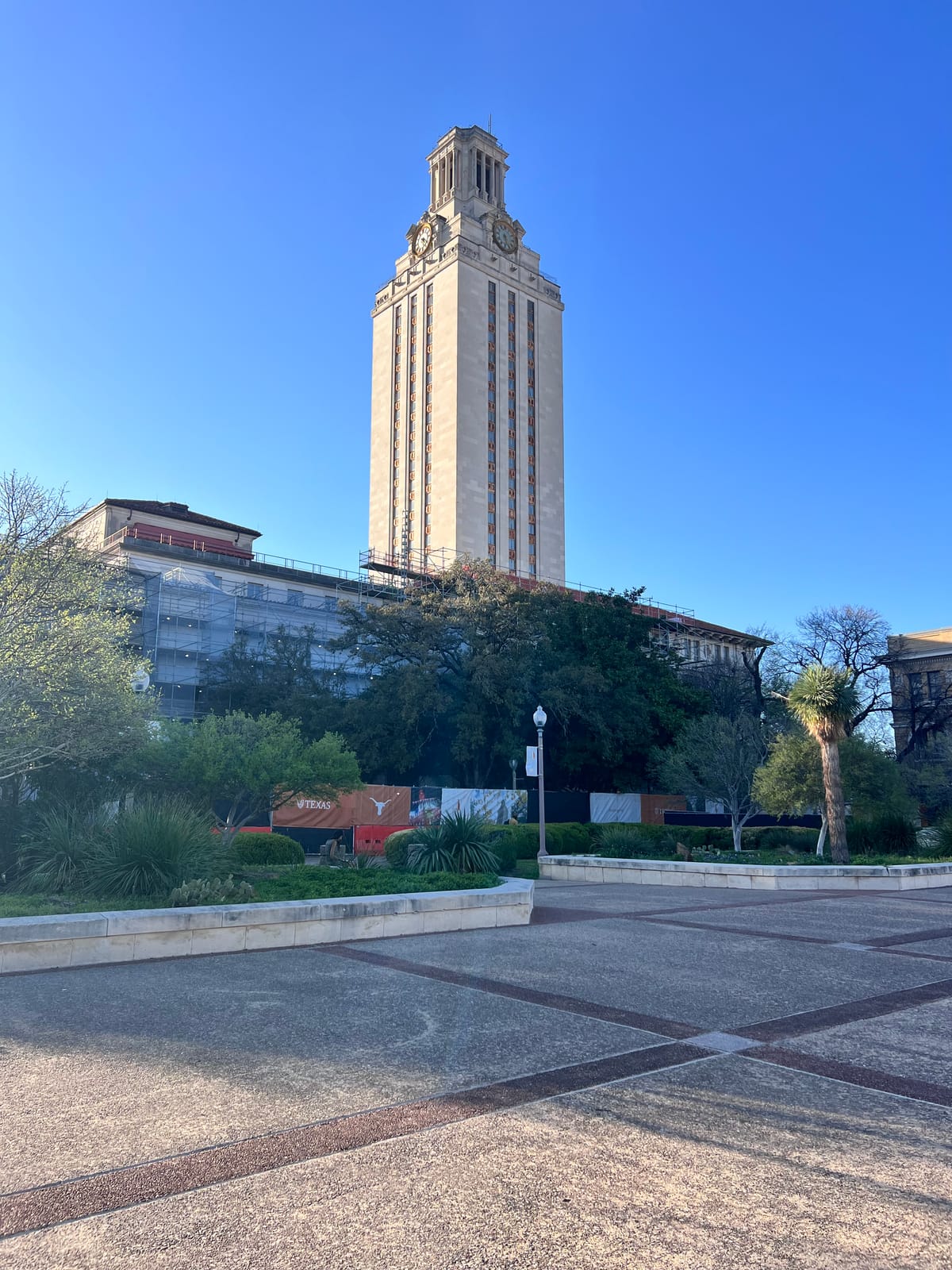
However, with the state's eagerness to support operations and the university refusing to offer a clear pathway of protections for students, those potentially affected by ICE raids have begun to speak up in protest. Many of these protests against ICE have taken place on the UT Austin campus; at high schools in and around Austin; and around the city capitol building. Students, aware of the potential consequences that may result from protesting, took to the university's tower to share their disappointment in university officials.
Even with some assurances, many students don’t feel safe and even feel like targets because of their phenotype. As Hernandez put it, "The thought of being taken away from my loved ones is one of my biggest fears, and I can hardly bear the thought of it." Students continue to proceed with caution as they attempt to manage responsibilities with the added worries of safety. With the protections rescinded and with continuous raids and arrests conducted by ICE agents, many students and their families feel under siege in their communities, with no clear end in sight.