Bats! Bridge and Bracken Bats!!
Experiencing the bats emerging from under the Congress Avenue Bridge at dusk, in summer especially, is an Austin activity rivaled by few other local appreciations of the natural world. There’s the all-over body shock of jumping into Barton Springs, summiting the small height of Mount Bonnell to see people get proposed to, and then there are the bats.
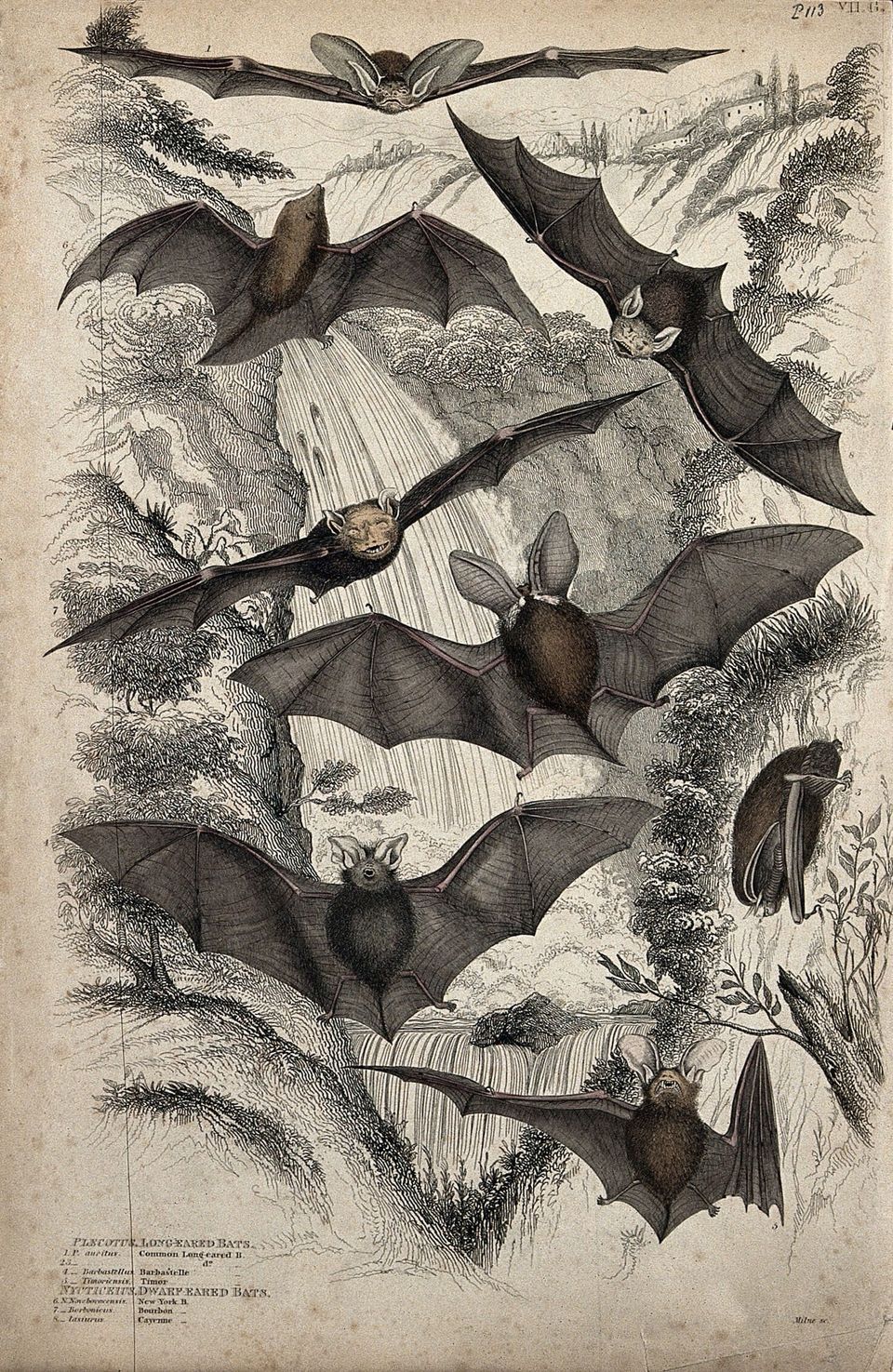
The Mexican free-tailed bat — also known as the Brazilian free-tailed bat, confusingly — can also be refereed to in scientific settings by the classification Tadarida brasiliensis (which inspired the name of this very website). See the bat here — note the dull points on the top of the ears and the horizontal grooves inside. The lines on the mouth almost give our bat a whimsical, knowing expression.
Our wonderment at the free-tailed bat is, in part, tied to their immense hunger and the immense good this hunger does for our crops, farmers, and our world. The bats emerge each evening to hunt and kill a dazzling amount of prey. “Free-tailed bats of Central Texas consume close to 200 tons of insects on an average summer night, essential to keeping ecosystems healthy,” reports Austinbats.org.
It’s strange now to think about the fussy, dramatic response that met the mammals when they first began taking up residence under a bridge no one was utilizing the bottomside of anyway, with a headline in “the local paper” stating that there was “Mass Fear in the Air as Bats Invade City.” I visited our local library’s website to learn more about the hysteria, but the online archives for the Austin American Statesman do not go back as far as 1982 (they begin in 1989), and I was not about to spend more time in the Austin History Center to browse editorials fearmongering that the arrival of bats in Austin would mean every person in town was sure to find them tangled up in their tall, teased hair.
Distrust at our warm-blooded visitors had cooled by the late 80s and then faded into the past tense, steadily erased by the acknowledged ecological benefit of the bats' nightly moth massacres and the boon to Austin — especially as this was tied to the scores of tourists who gather to watch the bats burst into the skies on summer evenings.
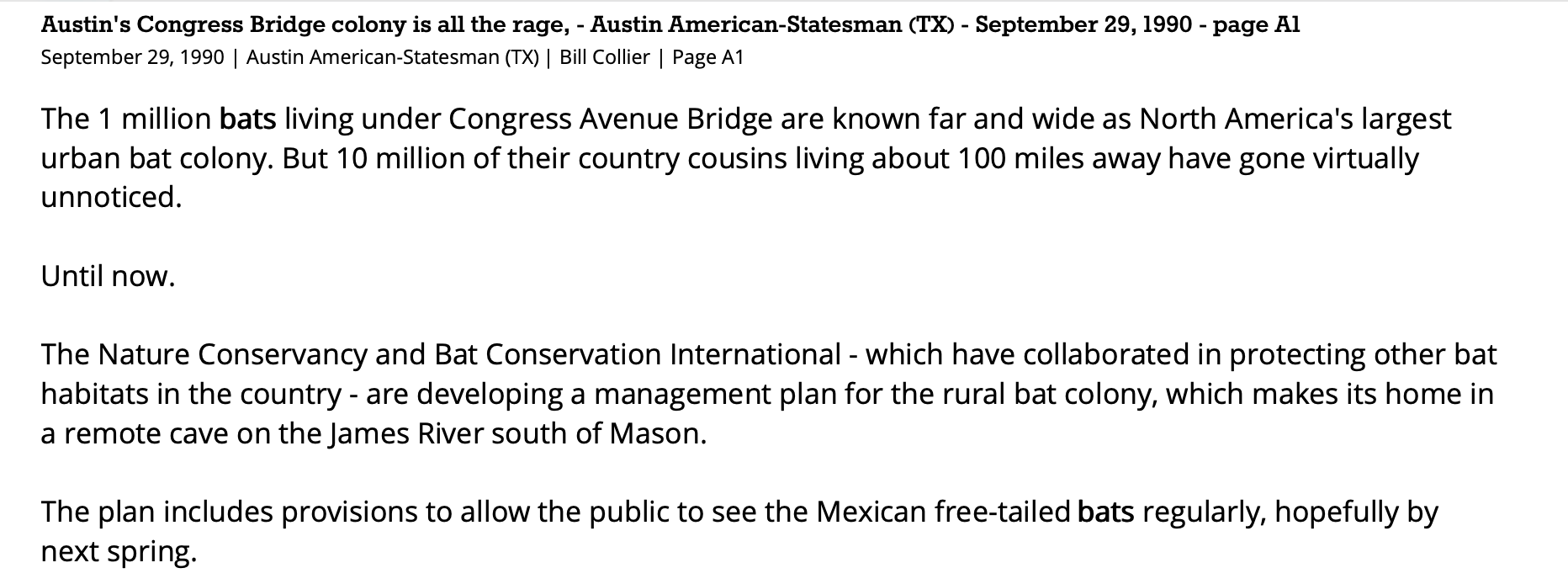
And as popular and applauded as our bridge bats now are, did you know an enormous colony of the same species can be found an hour and a half south of the city? Here is a 1990 piece in the Statesman that uses the bridge bats as an opener to discuss this even larger colony of furry flyers:
That remote cave is currently much less remote thanks to the Blob-like spread of development, but visiting what is now called Bracken Cave Preserve still has an aura of a shared secret about it, in part because the amount of visitors who can come see the bats make their nightly escapade is capped. Last month I was fortunate enough to experience my second visit to this Preserve, thanks to my visiting in-laws who gifted us with tickets. A collection of our friends and family drove in from Austin to experience both education and the immense batty energy the evening promised. The above Statesman article speaks about 10 million bats, but the latest number is 15 million (whether this is an increase in bats or a result of more accurate bat accounting, I do not know).
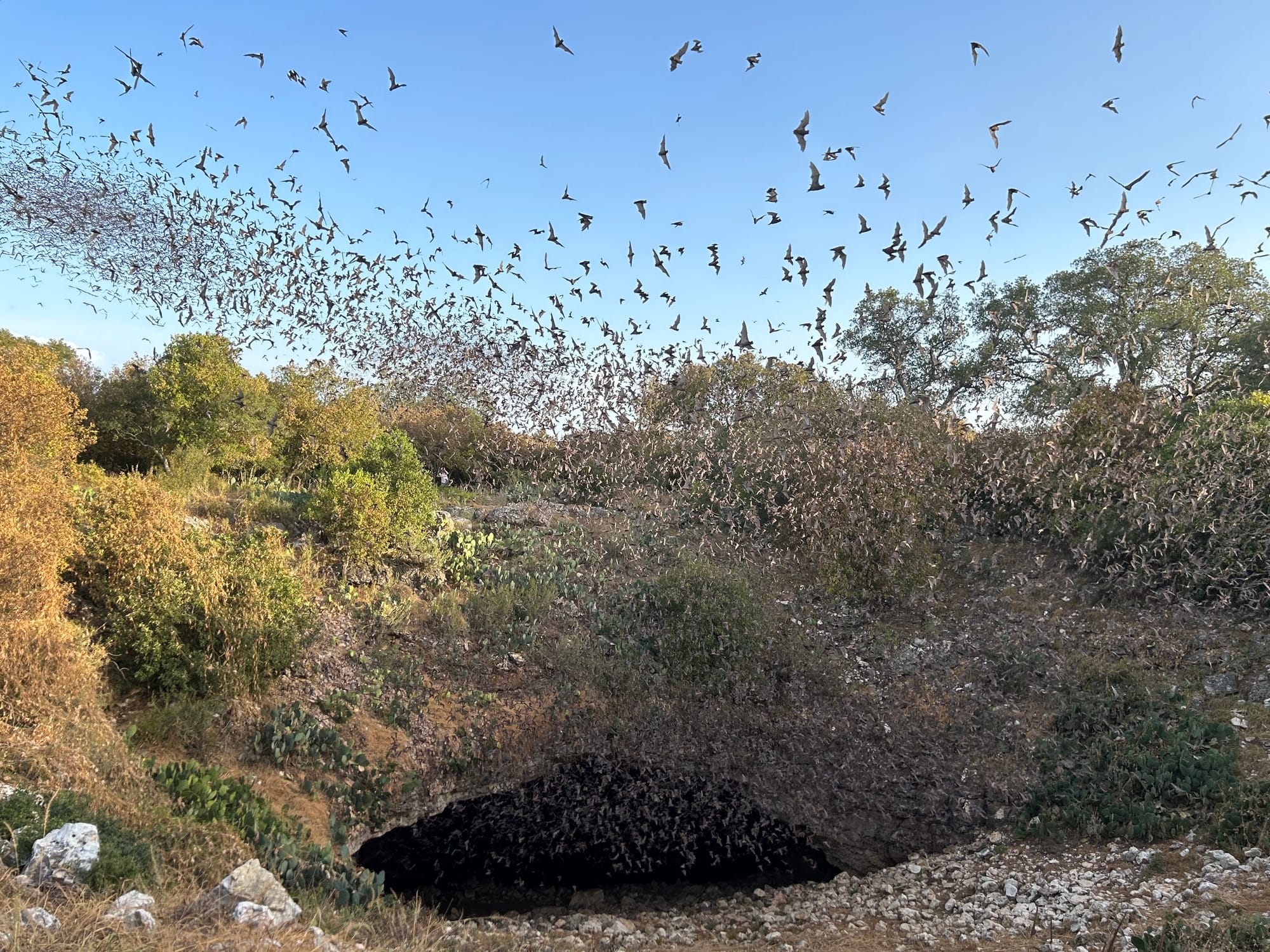
What I do know is that we were supposed to leave our handguns, snacks and dogs behind and invited to spend some time exploring the Preserve before listening to a lecture on bats and then going to see them emerge.

During this brief walk-around (near something called the Bat Gulp) is when I think chiggers began feasting on my skin, which became impossible to ignore when I was trying to sleep a couple of nights later.
A Preserve volunteer passed out copies of Bats Magazine, the official organ of Bat Conservation International, before beginning her presentation. I noticed the issue was rather backdated (2024), and seeing she was passing out another issue, I snagged one of those only to find out it was even older (2022). Our volunteer guide seemed confused by some basic bat facts, and misinformed us that the Bracken bats are a maternal colony while the Congress bats are paternal (both are maternal colonies), but soon the hypothetically informative portion of the evening was over and it was time to make the short walk to the cave.
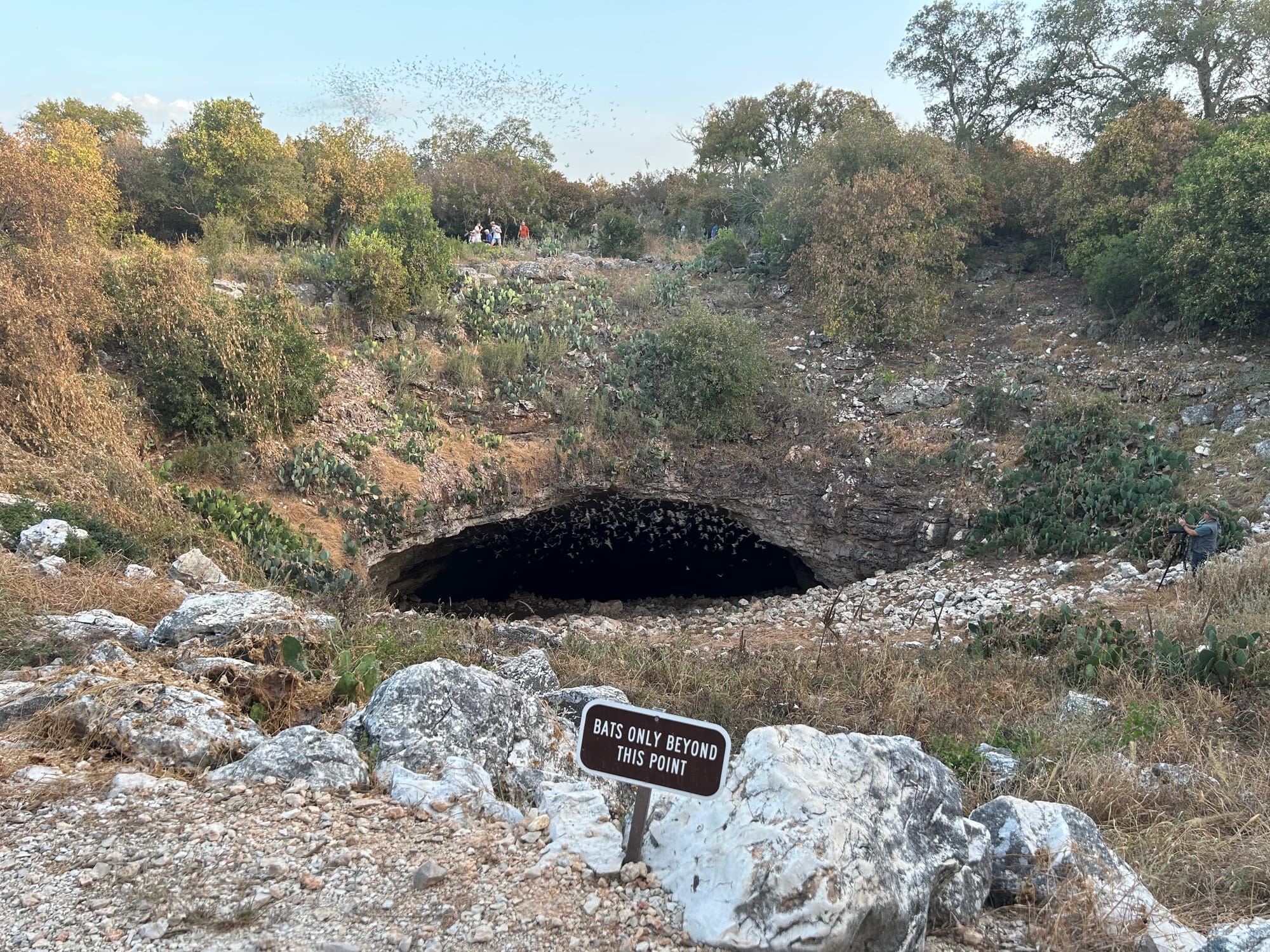
During my first visit in 2023, the bats came out earlier (closer to 8 p.m., and this evening they didn't really emerge until closer to 9 p.m.) and it was easier to get a full view of creatures above (hawks) and below (raccoons, skunks), and of the fluttering "batnado" (seen here in official merch and in the gif below). This evening, we watched as hawks begin to dive for errant bats, mostly unsuccessfully, and tried to see the earthbound, scuttling and stinky animals do whatever it is they do down there. We also heard — but could not see — the urgent oinking of what must have been wild pigs.
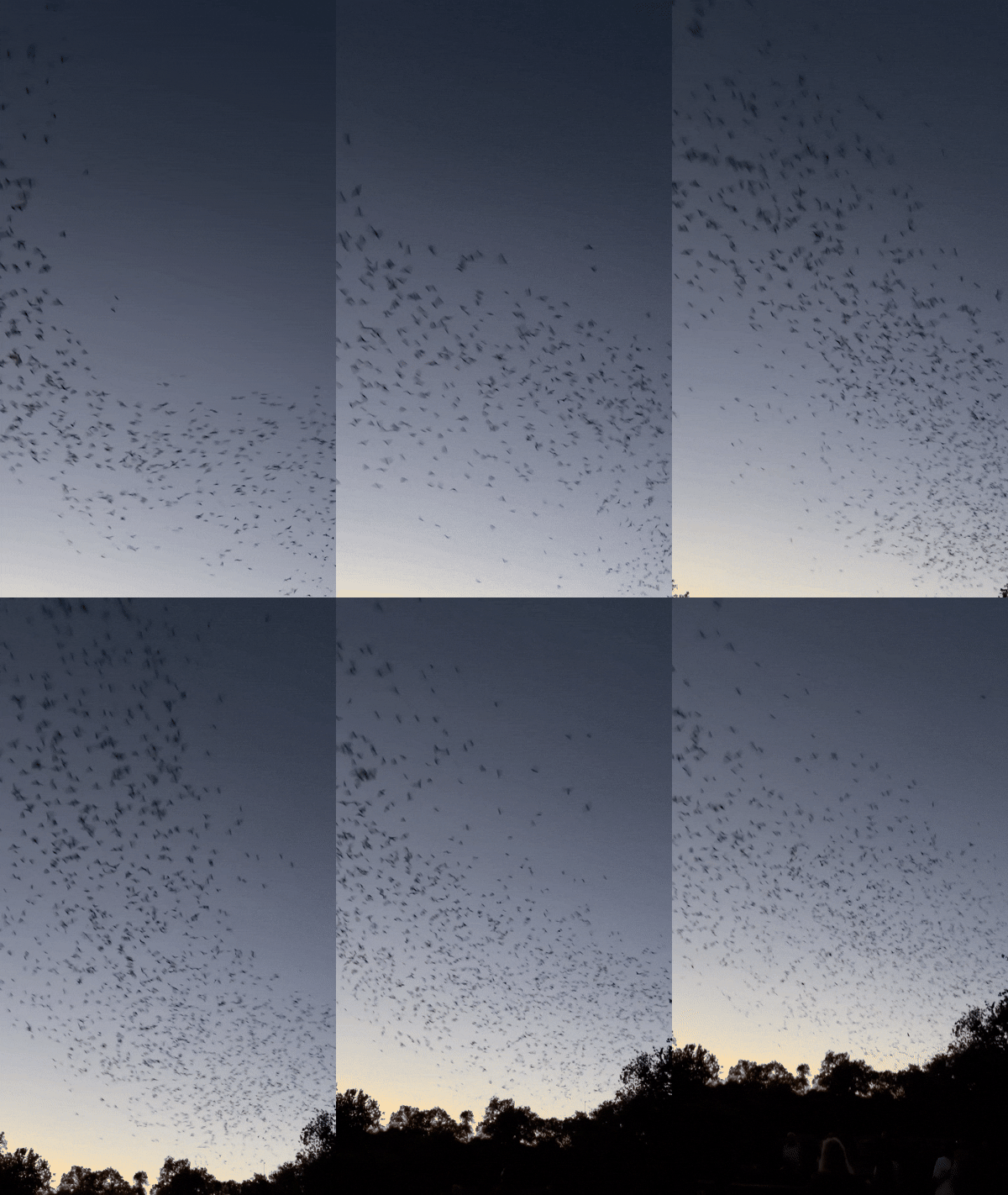
Then came the big show, the pouring out of millions of bats into the air and away from the cave, a quivering ribbon tilting this way and sometimes that. We were silent except for whispers, and the bats were quiet, too — the sound they made was strangely familiar to me but did not remind me of animals at all. I kept thinking it sounded like a shower curtain slowly opening or leaves crackling.
Millions of wings were beating at once as the bats unspooled, heading away from where we were sitting in a kind of semi-circle around the cave. Many of the gathered, which included one tween furry and quite a few grandparents, then moved to where the bats were directly flying overhead. The tween laid down on the ground to watch the bats, and I cringe in empathy to imagine what the chiggers made of that easy meal. The bats shushed us with their flight, never colliding into the attendant watchers or skittering into the ground. The batnado has a bendy, determined logic to it. Moths must shudder to see it begin to take shape.
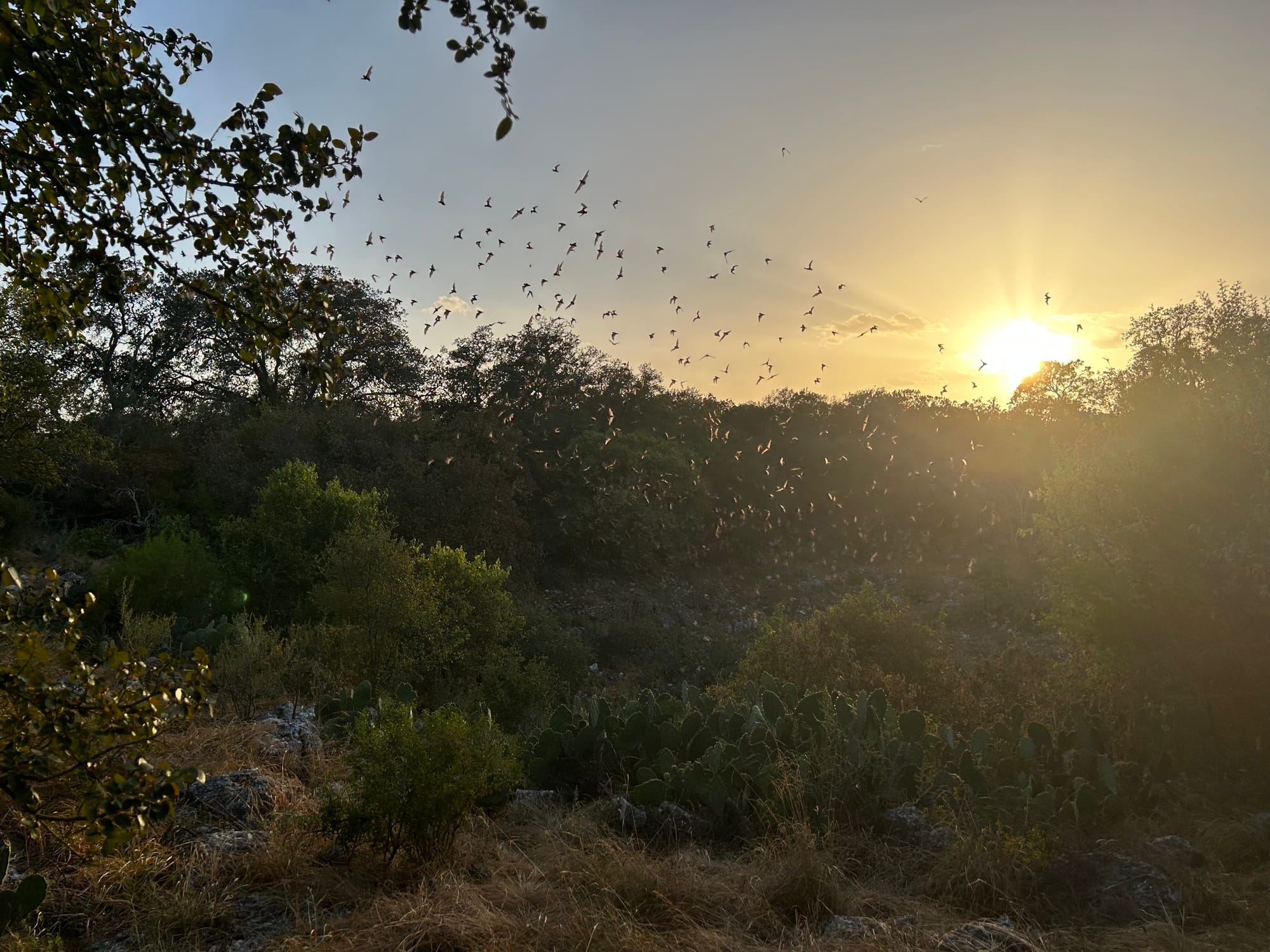
Visiting the home of the largest concentration of mammals — let alone bats — on earth is, even with the chiggers, an eternal recommendation from me. While the roosting of the Congress bats is a happy accident, to see (and smell, and hear) the bats living their best furry lives where they truly want to belong is something special. If you like what you see over the Austin skies, you're going to love seeing them at the Bracken Cave Preserve. Just wear pants and not shorts if you're planning on walking through the grass near the Bat Gulp.
Note: I initially thought I first visited Bracken in 2024, but it was actually 2023. I regret spreading my own misinformation. The piece has also been augmented by photos from Leah Churner from that visit.